In this article ▾
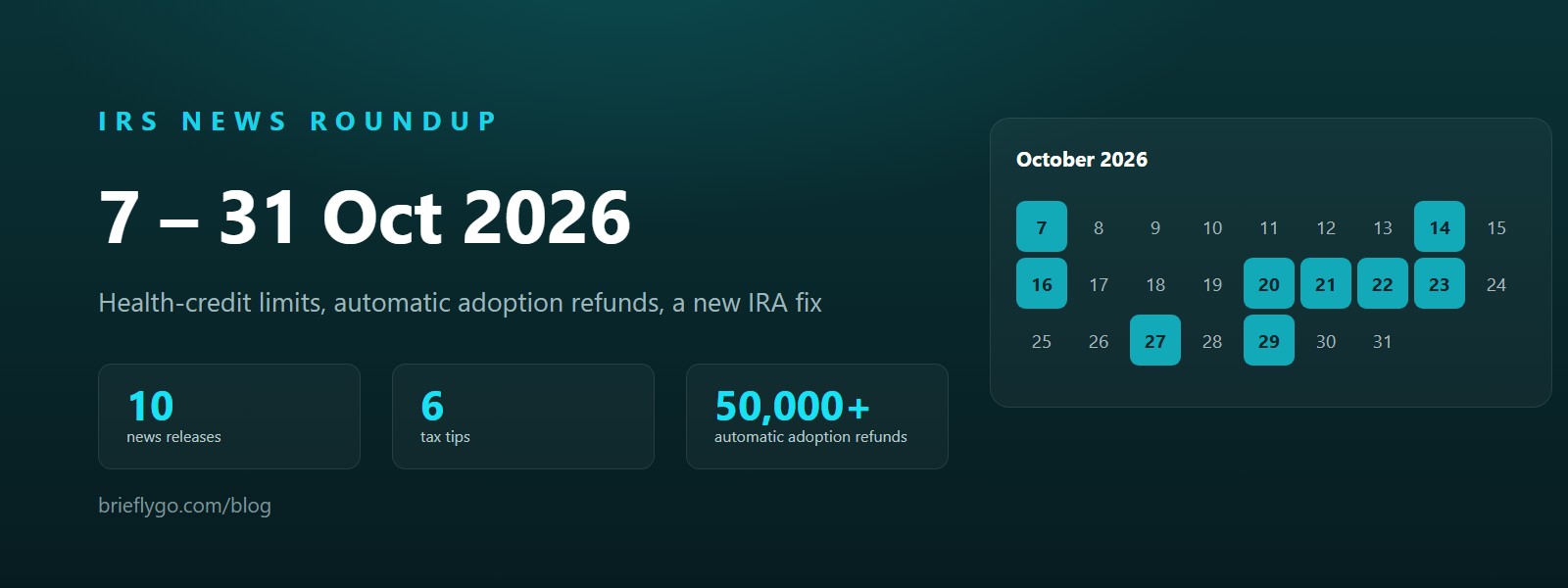
Quick answer: The IRS published ten news releases (IR-2026-120 to IR-2026-129) and six tax tips (2026-73 to 2026-78) between 7 and 31 October 2026. Three items change what people will actually file or receive. First, proposed rules restrict the Premium Tax Credit from 2027 to US citizens, US nationals and certain lawfully present noncitizens; comments close 30 November. Second, the IRS is sending automatic refunds to families with adoption credit carryforwards: more than 50,000 so far, with no amended return needed. Third, two revenue procedures overhaul retirement-plan corrections and create the first formal correction programme for IRAs. Around them: nationwide penalty relief for dyed diesel used on highways, Hurricane Isaias relief in Florida and Alabama, and relief for 62 Texas counties. Two things did not happen: as of 31 October, the IRS had not published the 2027 inflation adjustments or the 2027 retirement contribution limits.
Last verified: 31 October 2026, against the IRS newsroom, the IRS guidance drop, the Internal Revenue Bulletin, the Federal Register and USCIS. Covers items published 7–31 October 2026. This article is educational and is not tax, legal or immigration advice. A CPA, enrolled agent, tax attorney or immigration attorney should advise on your specific facts.
The through-line: the new law starts deciding who gets paid
The previous roundup showed the Working Families Tax Cuts turning into forms. This window shows them turning into eligibility rules and money movements. The Premium Tax Credit rules narrow who can claim. The adoption credit reinterpretation pays out without anyone asking. The IRS's own year-end release (IR-2026-129) counts the result in refunds and Trump Accounts.
The rest is the usual October mix. There is security messaging, a Tax Professional Awareness Week, and disaster relief, this time from a hurricane. The most practical item for many readers is a reminder buried in a security release: the IP PIN system goes offline in mid-November.
Premium Tax Credit: eligibility narrows from 2027 (IR-2026-121)
On 14 October Treasury and the IRS issued proposed regulations (REG-101576-26, Federal Register document 2026-21056, published 15 October). They implement the 2025 law's changes to the Premium Tax Credit (PTC), the refundable credit that helps people pay for health insurance bought on a Health Insurance Exchange.
- Who qualifies. From 2027, the PTC is limited to US citizens, US nationals and certain lawfully present noncitizens ("eligible aliens").
- Family members. For tax years beginning after 31 December 2026, premiums for family members who are lawfully present but are not eligible aliens are excluded when the credit is computed. Exchanges would leave those amounts off Form 1095-A.
- Below 100% of the poverty line. The rules remove the provision that let certain lawfully present immigrants with income below 100% of the federal poverty level qualify when their immigration status made them ineligible for Medicaid.
- Verification. New eligibility checks and verification criteria apply to advance PTC payments. HHS is expected to issue parallel rules on Exchange procedures.
- Comments and hearing. Written comments are due 30 November 2026. A telephonic public hearing is scheduled for 8 December 2026 at 10 a.m. ET; requests to attend are due 4 December.
The release also cites CMS figures: more than 760,000 unverified enrollees removed from ACA rolls, $2.2 billion in savings, and nearly 1 million people refunded $500 each.
"Today's proposed rules implement the common-sense reforms enacted by the Working Families Tax Cuts," said Treasury Secretary Scott Bessent.
The practitioner read: the PTC is reconciled on Form 8962, so mistakes show up a year late, as a repayment. A mixed-status household that enrols for 2027 on the old assumptions can receive advance credit all year and then owe it back. Open enrolment for 2027 coverage starts on 1 November, before these rules are final. Check the immigration status of each household member before choosing a plan, not after the 1095-A arrives.
Adoption credit: automatic refunds, no amended return (IR-2026-123)
Treasury reinterpreted the 2025 law's change to the adoption credit. For tax year 2025 only, adoption credit carryforwards from tax years 2020 to 2024 can increase the refundable portion of the credit. The $5,000 per qualifying child limit on the refundable portion still applies.
- Scale. Adjustments began in late September. More than 50,000 taxpayers had received refunds by 16 October, and the IRS expects to finish most by year-end.
- Action needed. Generally none. People who filed their 2025 return by 15 April 2026 should be adjusted automatically, without filing a Form 8839 correction or an amended return.
- Later reviews. Returns filed on extension, and accounts with identity-theft indicators, freezes or dependency conflicts, will be reviewed later in 2026.
- Notices. A notice generally follows within 30 days of an adjustment. It states the amount and whether it was refunded or offset against another tax or non-tax debt.
The practitioner read: an offset is the surprise here. A family expecting a cheque may get a notice saying the money went to an old balance or a non-tax federal debt. Keep the notice with the 2025 return. If a client filed on extension, the adjustment has not happened yet, and an amended return is not the way to speed it up.
Retirement-plan and IRA corrections overhauled (IR-2026-126)
On 22 October Treasury and the IRS issued two revenue procedures. Together they are the biggest change to plan corrections since 2021.
| Rev. Proc. 2026-34 (EPCRS) | Rev. Proc. 2026-33 (ICRS) | |
|---|---|---|
| What | Restates the Employee Plans Compliance Resolution System and replaces Rev. Proc. 2021-30 | Creates the IRA Compliance Resolution System, the first formal correction programme for IRAs |
| Who | Sponsors of qualified plans, 403(b) plans, SEPs and SIMPLE IRAs | IRA custodians and IRA owners, for eligible inadvertent failures caused by service-provider errors |
| Effective | 22 October 2026 | 1 May 2027 |
| Key change | Builds in SECURE 2.0: self-correction of eligible inadvertent failures, including loan failures, without a favourable determination letter | 60-day rollover waivers move here from private letter rulings: either route in 2027, ICRS only from 2028 (anticipated) |
| Fees | — | $3,500 per regular IVCP submission; group submissions $10,000 for the first 10 IRA owners plus $250 each after that, capped at $50,000 (for submissions before 1 January 2028) |
| Comments due | 20 January 2027 | 20 January 2027 |
One detail in Rev. Proc. 2026-34 sets a clock. A self-correction is deemed completed within a reasonable period if it is finished by the later of the last day of the third plan year after the failure, or 18 months after the failure is identified. That is more generous than the 18-month rule in the interim guidance, Notice 2023-43. Once a plan is under examination, self-correction is generally available only if the sponsor had already shown a specific commitment to correct, or if the failure is insignificant.
The practitioner read: the 60-day rollover waiver is the change individuals will notice. Until now a missed rollover needed either the free self-certification under Rev. Proc. 2020-46 or a private letter ruling, with its user fee and wait. Self-certification still exists. For cases it does not fit, ICRS becomes the route from May 2027. For plan sponsors, the 18-month clock starts when a failure is identified, so write down that date when an audit or a vendor finds an error.
Dyed diesel on highways: penalties suspended to year-end (IR-2026-122, IR-2026-125)
After a 5 October executive order titled Emergency Tax Relief on Diesel Fuel, the IRS announced on 14 October that it will not impose penalties when dyed (normally tax-exempt) diesel is sold for use or used on highways nationwide. The relief runs from 1 October to 31 December 2026.
- Enforcement paused. There are no federal inspections of on-road dyed fuel use. Fuel compliance officers have been reassigned, and normal collection is suspended.
- Sellers. Sellers and distributors do not have to investigate or document how the fuel is used.
- Reporting (IR-2026-125, 21 October). The IRS will not challenge failures to file Form 720, report, or keep records solely for the section 4041(a) liability on dyed diesel used from 1 October to 31 December 2026. It will not ask for those filings or records later.
- Not covered. State fuel taxes, and every other Form 720 liability. Many, but not all, states have offered similar relief.
- Still open. The IRS expects further guidance on postponing the tax itself under section 7508A, and is considering a grace period for red dye left in tanks after 31 December.
The practitioner read: what is suspended is penalties, enforcement and reporting. The releases do not say the tax has been repealed; they say guidance on deferring it is coming. A business that files Form 720 for other excise taxes must keep filing for those. The 1 January cliff matters too: a tank of dyed fuel in a road vehicle on 2 January is back under the normal rules unless the promised grace period appears.
Disaster relief: Hurricane Isaias, Texas and four more states
| Area | Release | Disaster began | Deadlines postponed to |
|---|---|---|---|
| Florida: 27 counties (Hurricane Isaias, FEMA 3655-EM) | FL-2026-07, 14 Oct | 6 Oct 2026 (amended on 22 Oct from 9 Oct) | 8 Feb 2027 |
| Alabama: 40 counties (Hurricane Isaias) | AL-2026-01, 14 Oct | 7 Oct 2026 | 4 Feb 2027 |
| Texas: 62 counties (July storms) | TX-2026-05, 27 Oct | 14 Jul 2026 | 1 Feb 2027 |
| Nebraska: Knox County | NE-2026-08 | 9 Sep 2026 | 7 Jan 2027 |
| Ohio: 7 counties | OH-2026-02 | 10 Aug 2026 | 1 Feb 2027 |
| West Virginia: Fayette, Harrison, Kanawha | WV-2026-02 | 14 Aug 2026 | 4 Feb 2027 |
| Wisconsin: 4 counties | WI-2026-03 | 27 Jul 2026 | 1 Feb 2027 |
All seven postpone return filing, tax payments, and quarterly estimated payments that fall due within the window. In Florida that includes the third-quarter Form 941 due 2 November and the fourth-quarter return due 1 February 2027. The usual exclusions apply: the 2025 balance due on 15 April 2026 is not postponed, and neither are W-2, 1099 and other information returns.
The practitioner read: the Florida release was amended on 22 October to move the start date back three days, to 6 October, to match FEMA. The amended deposit-penalty window (deposits due 6–20 October, made by 21 October) still sits beside the original 26 October date in the body text. Use the update note, and keep a copy of the page as it stood when you relied on it. Taxpayers outside the listed counties who were affected can call 866-562-5227.
The IRS marks its own year (IR-2026-129)
On 29 October the IRS published its fiscal-year 2026 results:
- $5.6 trillion collected, a record and up nearly 5%.
- Total refund dollars up 17% and the average refund up 11%; about 90% of e-filers were refunded within 21 days.
- Individual Online Account users up 34% to about 37.6 million, with 224 million logins. Online payments up 57% to more than $133.6 billion.
- The new IRS app: more than 140,000 downloads in its first five days.
- About $38 billion protected from identity-theft refund fraud.
- Trump Accounts: nearly 70 million open, 27 million funded by families, donors or the government. The $1,000 government contribution covers children born from 1 January 2025 to 31 December 2028.
The practitioner read: these are the IRS's own figures, published by the agency being measured, and the release does not report phone service levels. The gap between 70 million accounts and 27 million funded is the number for families: an account that exists is not an account that has received the seed money.
Security and the IP PIN deadline (IR-2026-127, Tax Tips 2026-75 and 2026-78)
IP PIN maintenance (22 October). The Identity Protection PIN is a six-digit number that stops anyone else filing a federal return with your SSN or ITIN. Anyone can get one. The IRS says people who want to file early in 2027 should request it before the online system goes down for annual maintenance in mid-November. It generally comes back in mid-January. The IRS never asks for an IP PIN by phone, email, text or social media.
Tax credit scams (Tax Tip 2026-78, 29 October). The IRS again names "Tribal Tax Credits" and "Native American Tax Credits" as fake. It adds two newer pitches:
- a general "self-employment tax credit", which does not exist as a single credit;
- misuse of the Fuel Tax Credit, which is generally limited to qualifying business uses such as non-taxable off-highway use.
The red flags are the same as in September: discounted credits, "act fast", agreements that are not public, legal opinions nobody can verify, and non-disclosure agreements.
For tax professionals (Tax Tip 2026-75, 20 October). Tax Pro Account now lets a firm manage business CAF access, including which employees may act under it. Pair it with an updated Written Information Security Plan.
The practitioner read: the IP PIN date is the one to act on this week. A client who was an identity-theft victim, or who simply wants to file in late January, should get the PIN now. Once the system is down they cannot get one online until mid-January. The Fuel Tax Credit warning also connects to section 4: dyed-diesel relief does not create a credit for fuel that was never taxed.
The smaller items
- IR-2026-120 (7 October): IRS and HMRC on whistleblowers. The IRS helped stand up HMRC's Strengthened Reward Scheme, launched in November 2025, for serious avoidance and evasion by the wealthiest individuals and largest businesses. Whistleblowers need not be US or UK citizens or residents to receive an award.
- IR-2026-124 (16 October): Tax Professional Awareness Week, the week of 19 October. A 21 October webinar on refundable credits, and videos on Form 8867 due diligence and Schedule C errors.
- IR-2026-128 (23 October): year-round planning. Check withholding with the Tax Withholding Estimator and file a new Form W-4 if needed. Keep W-2s, 1099s and records of digital-asset transactions as they arrive. Publication 5349-A is the checklist.
- Tax Tip 2026-74 (14 October) reminded extension filers that 15 October was the last day. Tax Tip 2026-73 (7 October) continued the Taxpayer Bill of Rights series with the right to a fair and just tax system.
- Tax Tips 2026-76 and 2026-77 (22 and 27 October): retirement. The 2026 IRA limit is $7,500, plus $1,100 catch-up from age 50 ($8,600 in total). Required minimum distributions generally start at age 73.
Guidance that came without a press release
| Item | What it does | Who should care |
|---|---|---|
| Rev. Proc. 2026-20 (6 October) | Safe harbour letting grantor investment trusts stake digital assets without losing their tax status. Supersedes Rev. Proc. 2025-31. Existing trusts have six months from 6 October 2026 to amend trust agreements and processes | Crypto ETP sponsors and their investors |
| Rev. Rul. 2026-21 (16 October) | November 2026 applicable federal rates: short-term 4.67%, mid-term 5.08%, long-term 5.52% (annual). Section 7520 rate 6.20% | Family loans, instalment sales, estate planning |
| Notice 2026-65 (20 October) | Monthly corporate bond yield curve and segment rates for pension funding and lump-sum calculations | Defined benefit plan actuaries |
| Rev. Rul. 2026-22 (28 October) | Holds that a pension plan's section 401(h) account may pay retiree medical benefits for participants aged 59½ or older who take in-service distributions but have not separated from employment | Pension plan sponsors with retiree medical accounts |
The practitioner read: the AFRs moved sharply. October's short-term and mid-term rates were 4.25% and 4.61%. November's are 4.67% and 5.08%. An intra-family loan or instalment note signed in October locked in the lower rate. One signed in November needs the new minimum to avoid imputed interest.
Beyond the IRS: USCIS
- Form I-539 and I-765 editions: unchanged since our last roundup. As of the form pages' 7 October update, USCIS still accepts the 08/28/24 edition of Form I-539 and the 08/21/25 edition of Form I-765, and does not accept the 09/15/26 editions. DHS says it disagrees with the court order and will implement the rule if the order is lifted.
- Sileiri Doe v. DHS (alert of 26 October). CBP One parolees whose parole was ended by email in April 2025 can ask USCIS to reopen or reconsider an adverse decision issued between 1 April 2025 and 21 April 2026, without a fee. Asylum cases use Form I-589; other benefits use Form I-290B. There is no deadline. Parole-based work permit requests are excluded.
- New asylum office in Charlotte, North Carolina (alert of 9 October).
- Carried forward: the FY2027 fee increases took effect for filings postmarked from 16 October. Only the 09/09/26 edition of Form I-129 is accepted from 9 November. New EB-5 fees are scheduled for 30 November.
What to actually do, by who you are
| If you are… | Do this | By when |
|---|---|---|
| Planning to file early in 2027, or a past ID-theft victim | Get an IP PIN through your online account or the IRS app | Before mid-November |
| Buying 2027 Marketplace coverage in a mixed-status household | Check each member's eligibility under the proposed PTC rules before taking advance credit | Open enrolment from 1 Nov; comments by 30 Nov 2026 |
| An adoptive parent with a carryforward | Do nothing unless you filed on extension; watch for the IRS notice and keep it | Most adjustments by year-end |
| A plan sponsor | Record the date each failure is identified; review loan and SECURE 2.0 corrections against Rev. Proc. 2026-34 | In effect since 22 Oct 2026 |
| Someone who missed a 60-day rollover | Use self-certification where it fits; otherwise ICRS from May 2027 or a letter ruling | ICRS from 1 May 2027 |
| A fuel retailer or fleet operator | Keep filing Form 720 for other liabilities; plan for the 31 December end of dyed-diesel relief | 31 Dec 2026 |
| In a Florida, Alabama, Texas, Nebraska, Ohio, West Virginia or Wisconsin disaster county | Confirm your county and your postponed date | 7 Jan – 8 Feb 2027 |
| Lending to family or selling on instalments | Use the November AFRs for anything signed this month | November 2026 |
| Still filing information returns on FIRE | Move to IRIS | FIRE closes 19 Nov 2026, 3 p.m. ET |
Dates that follow from this window
| Date | What | Who |
|---|---|---|
| 1 November 2026 | Marketplace open enrolment for 2027 coverage begins | Exchange enrollees |
| 2 November 2026 | Q3 Form 941 due (10 November if all deposits were on time); postponed in disaster counties | Employers |
| 3 November 2026 | Comments close on the private-school proposed rules (REG-119986-25) | Tax-exempt schools |
| 9 November 2026 | T.D. 10054 (car-loan interest) takes effect; only the 09/09/26 edition of Form I-129 accepted | Lenders; petitioning employers |
| Mid-November 2026 | IP PIN online tool goes offline for annual maintenance | Anyone wanting an IP PIN |
| 19 November 2026, 3 p.m. ET | FIRE stops accepting submissions permanently | Information-return filers |
| 23 November 2026 | Comments close on Notice 2026-55 (Opportunity Zones) | OZ investors |
| 30 November 2026 | Comments close on the PTC proposed rules and on the farmland instalment rules; new EB-5 fees take effect | Exchange enrollees; farmland sellers; EB-5 investors |
| 8 December 2026 | Public hearing on the PTC proposed rules, 10 a.m. ET | Commenters |
| 31 December 2026 | Dyed-diesel penalty and reporting relief ends | Fuel sellers and users |
| 1 January 2027 | New PTC eligibility rules apply (if finalised); Education Freedom Tax Credit begins; IRIS only for information returns | Enrollees; donors; filers |
| 7 January – 8 February 2027 | Postponed deadlines in the seven disaster areas above | Disaster-area taxpayers |
| 20 January 2027 | Comments close on Rev. Proc. 2026-33 and 2026-34 | Plan sponsors, IRA custodians |
| 6 April 2027 | End of the six-month window for existing trusts to adopt the staking safe harbour | Crypto trust sponsors |
| 1 May 2027 | ICRS opens | IRA custodians and owners |
What has not come out yet
As of 31 October, two documents the IRS usually publishes in October had not appeared on the newsroom or the guidance drop:
- the 2027 inflation adjustments, which set the brackets and the standard deduction for tax year 2027;
- the 2027 retirement plan contribution limits for 401(k), 403(b), 457 plans and IRAs.
Projections are circulating, some labelled "decided". They are not official. The 2026 standard deduction remains $16,100 (single), $32,200 (joint) and $24,150 (head of household). We will cover the 2027 numbers when the IRS publishes them.
Keeping up without reading the newsroom
October's lesson is that the most important items were not the loudest. The PTC rules came in one release among ten. The IP PIN deadline sat in the middle of a security reminder. The AFR jump was in a revenue ruling with no press release at all. And the Florida relief changed its own start date a week after it was issued.
The BrieflyGo form catalogue keeps current editions in one place across the IRS and USCIS. The tax calendar tracks the deadlines above.
Primary sources
- IR-2026-129: IRS achieved historic performance in 2026.
- IR-2026-128: Year-round tax planning can make filing easier.
- IR-2026-127: Take steps now to protect tax information.
- IR-2026-126: Treasury, IRS update retirement plan correction program and establish correction program for IRAs, with Rev. Proc. 2026-33 and Rev. Proc. 2026-34.
- IR-2026-125: Temporary reporting and recordkeeping relief for certain fuel uses.
- IR-2026-124: 2026 Tax Professional Awareness Week.
- IR-2026-123: Automatic refunds for Adoption Tax Credit carryforwards.
- IR-2026-122: Dyed diesel fuel relief.
- IR-2026-121: Treasury and IRS move to protect health care benefits for eligible Americans, with the Federal Register notice of proposed rulemaking.
- IR-2026-120: Partnership with the UK tax authority's whistleblower programme.
- Tax Tips 2026-73 to 2026-78: Taxpayer Bill of Rights, 15 October deadline, security tools for tax pros, IRAs, retirement and taxes and tax credit scams.
- Disaster relief: Florida (FL-2026-07), Alabama (AL-2026-01), Texas (TX-2026-05), and the IRS disaster relief index for Nebraska, Ohio, West Virginia and Wisconsin.
- Guidance: Rev. Proc. 2026-20, Rev. Rul. 2026-21, Notice 2026-65 and Rev. Rul. 2026-22.
- USCIS: Form I-539 page (court order notice), Sileiri Doe class members and Charlotte asylum office.
- Background: our roundups of 28 August – 11 September 2026 and 12 September – 6 October 2026.
Figures and dates above are transcribed from the IRS, Treasury, Federal Register and USCIS documents cited. Proposed regulations can change before they are final, and relief releases are sometimes amended after publication, as the Florida one was. None of it substitutes for advice on your own facts. Verify against the release itself before acting, and speak to a qualified tax professional or immigration attorney.