
September 11, 2026 · 13 min read
IRS News, 28 August – 11 September 2026: Private Schools, Clean Fuel, and Three Form Deadlines Nobody Announced
Eight IRS news releases and two tax tips from 28 August to 11 September 2026 — proposed rules stripping 501(c)(3) status from discriminatory private schools, Notice 2026-53 on the 45Z clean fuel credit, CAP 2027 applications closing 30 October — plus three USCIS form editions that expire with no grace period.
In this article ▾
Quick answer: The IRS published eight news releases and two tax tips between 28 August and 11 September 2026, and only two of them change any law: proposed regulations that would strip 501(c)(3) status from private schools that discriminate by race, and Notice 2026-53 on the 45Z clean fuel production credit. The rest is housekeeping — payroll week, disaster prep, identity theft, Direct Pay. The deadlines worth putting in a calendar this fortnight came from a different agency: USCIS replaces the accepted editions of Forms I-539, I-765 and I-485 on 15 and 18 September, with no grace period on either date.
Last verified: 11 September 2026, against the IRS newsroom and the USCIS newsroom. Covers items published 28 August – 11 September 2026. This article is educational and is not tax, legal or immigration advice. A CPA, enrolled agent, tax attorney or immigration attorney should advise on your specific facts.

The through-line: a thin fortnight at the IRS, a heavy one at the forms desk
The second half of August was about plumbing — a filing system switched off, a new authenticated document, an end to rolling settlement letters. This fortnight the IRS mostly repeated itself: three of the eight releases are reminders about tools that already existed, and two more are seasonal set-pieces tied to National Payroll Week and National Preparedness Month.
That is worth saying plainly rather than dressing up. Two items carry substance — the private-school regulations and the 45Z notice — and one carries a window that closes: CAP 2027 applications. Everything else is a nudge.
The dates that will actually cost someone money in the next ten days are not IRS dates at all, which is why this roundup ends somewhere the previous two did not.
1. Proposed rules would end tax-exempt status for discriminatory private schools (IR-2026-103)
On 3 September Treasury and the IRS issued proposed regulations under which a private school loses section 501(c)(3) status if it "adopts, maintains, or enforces a policy or practice that discriminates on the basis of race, color, or national or ethnic origin." The scope is wide: admissions, scholarships, athletics and every other school programme. Treasury put the number of affected institutions at roughly 18,000.
The proposal also removes existing IRS guidance that had permitted race-conscious preferences in admissions, facilities and financial assistance, on Treasury's reading that the older guidance no longer squares with Supreme Court precedent.
Two things stay permitted, and the distinction is the operative part of the rule:
- Religious selection. A religious school may still select students on genuine religious affiliation.
- Race-neutral criteria. Family income, geography, first-generation status, military family background and academic achievement all remain available.
"Schools rebranding race-based preferences as equitable … does not change their discriminatory nature," said Treasury Secretary Scott Bessent.
The final regulations would apply to tax years beginning on or after 31 May 2027 — an unusually long runway, and deliberately so, to give institutions time to rewrite policies. The proposal is open for comment through the Federal Register.
The practitioner read: the long effective date is the tell. This is not aimed at catching anyone out; it is aimed at forcing a policy rewrite, and the compliance work is documentary rather than financial. If you advise a school, the first pass is not the admissions policy everyone will reach for — it is the scholarship criteria, the athletics eligibility rules and any named fund whose deed of gift specifies a racial or ethnic class. Those are the provisions that were written decades ago, are rarely reread, and sit squarely inside "all school programs."
2. Notice 2026-53 sets the 45Z clean fuel rules (IR-2026-108)
On 8 September the IRS issued Notice 2026-53, implementing the section 45Z Clean Fuel Production Credit as amended by the Working Families Tax Cuts. It delivers the 2026 emissions rate table used to calculate the credit and resolves two questions producers had been waiting on.
What the notice does:
- Excludes indirect land use change emissions from the rate calculation.
- Prohibits negative emissions rates, with one carve-out: fuels derived from animal manure.
- Restricts eligible feedstock to material produced or grown exclusively in the United States, Mexico or Canada.
- Sets distinct rates for dairy and swine manure; poultry and beef manure are expected in model updates later in 2026.
- Recognises low-carbon agricultural practices consistent with USDA technical guidelines, with transition relief across 2025 and 2026 for the nutrient budget requirement that would otherwise have to be met before application.
The guidance "helps unlock billions of dollars for America's agricultural producers" and "provides greater certainty for investment across rural America," said IRS CEO Frank J. Bisignano.
The practitioner read: the North American feedstock restriction is the provision that reprices existing supply contracts, and it does so immediately rather than at some future effective date. A producer sourcing used cooking oil or tallow from outside the three countries is not looking at a reduced credit — the fuel simply does not qualify. The manure carve-out is narrower than the headline suggests too: dairy and swine have rates now, poultry and beef do not, and until the model update lands those projects are pricing on an unknown.
3. CAP 2027 applications are open — and close 30 October (IR-2026-107)
The Compliance Assurance Process, which has run since 2005, opened its 2027 application window on 8 September. It closes 30 October 2026, and the IRS notifies applicants in February 2027. CAP resolves issues with the IRS before a return is filed rather than through a post-filing examination — what the agency calls "real-time issue resolution through transparent and cooperative interaction between large corporate taxpayers and the IRS."
| Requirement | Detail |
|---|---|
| Assets | $10 million or more |
| Legal status | Not under investigation or in litigation with any government agency in a way that would limit IRS access to tax records |
| Financial reporting (public) | Publicly traded corporation filing SEC Forms 10-K, 10-Q and 8-K |
| Financial reporting (private) | Privately held C corporation providing audited annual statements (GAAP, IFRS or an IRS-approved method) plus unaudited quarterly statements, with an unqualified audit opinion |
The practitioner read: the asset floor is low enough that CAP is worth a look further down the market than most people assume — $10 million is not a large-corporate threshold in any other context. The real gate is the second row. An open dispute with any agency, not only the IRS, can disqualify you, and that is the kind of fact a tax director may not be the first to hear about. Check it before spending time on the application, not after.
4. Identity theft: the three layers the Security Summit wants in place (IR-2026-106)
On 4 September the Security Summit closed its summer "Protect Your Clients; Protect Yourself" series with a consolidated piece on defending against tax identity theft. Three layers, in the order the release puts them:
Multifactor authentication. Two independent factors — something you know, something you have, something you are. This is not optional for tax preparation firms: the FTC Safeguards Rule requires it, which is the same rule behind the Written Information Security Plan reminder from 18 August. The Summit wants it enabled on tax software, cloud storage, email and every other point that touches client data.
Identity Protection PINs. A six-digit number known only to the taxpayer and the IRS, valid for one calendar year and reissued annually. Two details practitioners get wrong: a tax professional cannot request an IP PIN on a client's behalf — the taxpayer must obtain their own through the Get an Identity Protection PIN tool — and confirmed identity theft victims receive one automatically each year without asking.
Secure online accounts. Individual Online Account for taxpayers, Tax Pro Account for practitioners submitting powers of attorney and managing authorisations electronically.
"Using multifactor authentication, IP PINs, and other protections adds important layers of security that helps safeguard sensitive data," said Bisignano.
The practitioner read: the IP PIN is the only one of the three that a thief cannot work around by compromising a password, because it is a number the IRS will not issue to anyone but the taxpayer. It is also the one with the worst adoption, precisely because the client has to do it themselves and nobody can do it for them. If you send one email to your list this autumn, make it the IP PIN one, and send it before January when the tool is busiest.
5. National Payroll Week: the paycheck checkup (IR-2026-105)
National Payroll Week ran 7–11 September 2026. The release is the annual prompt to revisit withholding after a life change — a new job, a marriage or divorce, a child, a shift in income — using the IRS Tax Withholding Estimator and then filing a fresh Form W-4 with the employer.
For employers and payroll teams the release lists the duties in plain order: withhold federal income, Social Security and Medicare tax accurately; deposit federal taxes electronically; file employment tax returns on time; keep employment records for at least four years; and protect payroll data through verified channels and multifactor authentication. Publication 15 and Publication 15-T are the reference texts; EFTPS is the deposit channel.
"Payroll professionals play an essential role in supporting America's workers, businesses, and tax system," said Bisignano.
The IRS also ran a webinar on 8 September — "IRS and Payroll Professionals – Partners in Every Paycheck" — covering employment tax deposits and Form W-2 reporting changes.
The practitioner read: the W-2 reporting changes are the part of that webinar worth chasing down the recording for. The Working Families Tax Cuts introduced deductions that depend on amounts an employer reports — overtime being the obvious one — and a W-2 that does not carry the figure in the expected place turns a client's deduction into a reconstruction exercise in February. This is a September problem, not a January one.
6. Disaster preparedness, and reconstructing what you lost (IR-2026-104, Tax Tip 2026-67)
September is National Preparedness Month, and the IRS ran the pair it runs every year — one release on preparing, one tip on recovering.
Before: keep returns, birth certificates, Social Security cards, insurance policies and property titles in waterproof and fireproof storage; scan paper records and hold a copy somewhere off-site; photograph or video the house, the business and the vehicles to support a later loss claim; review the plan annually.
After: transcripts come through Individual Online Account, by post, or on the automated line at 800-908-9946 (five to ten business days), with Form 4506-T as the formal request. For the rest, the tip is a checklist of who holds a copy of what — banks and card issuers for statements, the title company or lender for property purchase documents, contractors for improvement costs, probate court records for inherited property valuations, and the county assessor when nothing else survives. Vehicle dealers can supply the original purchase contract.
Taxpayers outside a declared disaster area who still need relief — records stored in the area, for instance — can call the IRS Special Services Hotline on 866-562-5227. Publications 547, 584, 584-B and 3067 carry the detail.
"Preparing now can make a real difference when a disaster strikes," said Bisignano.
The practitioner read: the photograph advice is the one clients skip and the one that decides casualty loss claims. Basis is the hard part of a casualty loss, not the fact of the loss, and a dated video walkthrough of a house is the cheapest contemporaneous evidence of contents that exists. Ten minutes with a phone, stored somewhere that is not the house.
7. Online services and Direct Pay (IR-2026-102, IR-2026-109)
Two reminders bookend the fortnight. On 28 August the IRS summarised what its three account types now do — Individual Online Account (balances, payments scheduled up to 365 days ahead, transcripts, refund status, digital notices, IP PINs, electronically signing a practitioner's authorisation request), Business Tax Account, and Tax Pro Account. Refund status is visible without signing in: 24 hours after e-filing a current-year return, three days for a prior-year e-filed return, four weeks for paper.
On 10 September it was Direct Pay: free, no registration, no sign-in, straight from a bank account. The limits are worth knowing before you rely on it:
| Feature | Detail |
|---|---|
| Cost | Free — no card processing fee |
| Scheduling | Same day, or up to 365 days ahead |
| Changing a payment | Cancel or modify up to two business days before the payment date |
| Maximum | Under $10 million per transaction — above that, wire or EFTPS |
| Cannot be used for | Receiving a refund; filers who have not filed in six or more years, or have never filed |
| Verification | Individuals: prior-year return details. Businesses: name and EIN matched to IRS records |
The practitioner read: the "no sign-in" design is the reason Direct Pay is the wrong tool for a client who owes across several years. There is no record of the payment in an account they can log into afterwards — only the confirmation number they were shown once. If the payment needs to be traceable later, and for anyone paying against an instalment agreement it does, use the online account or EFTPS and accept the enrolment friction.
8. Who can act for you: authorisations and the right to representation (Tax Tips 2026-66 and 2026-68)
Two tips, published a fortnight apart, cover the same ground from opposite ends. Tax Tip 2026-66 (27 August, just after our last roundup closed) sets out the four authorisation types:
| Type | What it allows | How long it lasts |
|---|---|---|
| Form 2848 — Power of Attorney | Represent, advocate, negotiate and sign on the taxpayer's behalf; receive copies of IRS notices. Representative must be qualified to practise before the IRS | Until revoked or withdrawn |
| Form 8821 — Tax Information Authorization | Review or receive confidential tax information for a specified tax type and period. No authority to act | Until revoked or withdrawn |
| Third Party Designee | Discuss one specific return and tax year, named on the return itself | One year from the return's due date, extensions not counted |
| Oral Disclosure | Share information with someone brought into a call or meeting | Automatically revoked when the conversation ends |
Tax Tip 2026-68 (9 September) covers the same relationship as a right under the Taxpayer Bill of Rights. Taxpayers may retain an attorney, CPA, enrolled agent, enrolled actuary or other person permitted to practise before the IRS and not disbarred or suspended. They need not attend an IRS interview personally unless formally summoned, and the IRS must generally suspend an interview when the taxpayer asks to consult a representative. Where cost is the barrier, Low Income Taxpayer Clinics handle audits, appeals and collection disputes free or at low cost, independently of both the IRS and the Taxpayer Advocate Service — 800-829-3676, or the LITC directory.
The practitioner read: the suspension right is the one clients do not know they have, and it only helps if they use it in the moment. A single sentence — "I would like to stop here and speak to my representative" — obliges the interviewer to stop. Tell clients the sentence before the interview, not after it. And the Form 8821 row is the one firms misuse: it is the correct instrument for a lender, a payroll bureau or a second adviser who needs to see data, and it is routinely replaced with a Form 2848 that hands over authority nobody intended to give.
Beyond the IRS: three USCIS form editions expire, two of them this month
If you file immigration paperwork, this is the part of the fortnight with a cost attached. USCIS rejects a superseded form edition outright — it does not issue a request for evidence — and on both September dates there is no grace period, because the revised editions are what implement the underlying final rules.
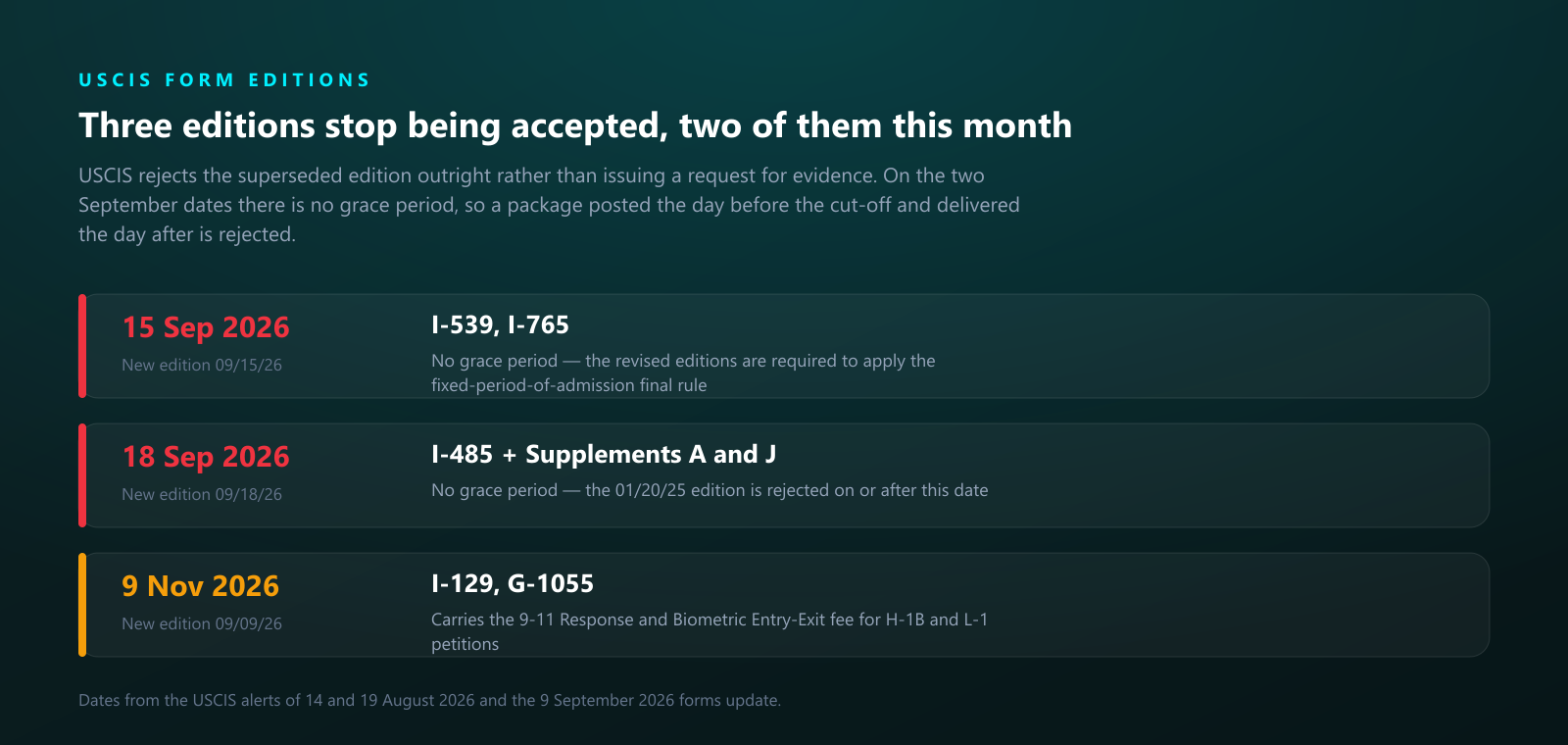
| From | Form | New edition | What drove the change |
|---|---|---|---|
| 15 September 2026 | I-539 (replacing 08/28/24) and I-765 (replacing 08/21/25) | 09/15/26 | The fixed time period of admission and extension of stay final rule for academic students, exchange visitors and foreign media representatives, published 17 July 2026 |
| 18 September 2026 | I-485 and Supplements A and J (replacing 01/20/25) | 09/18/26 | The public charge ground of inadmissibility final rule |
| 9 November 2026 | I-129 and G-1055 (Fee Schedule) | 09/09/26 | The 9-11 Response and Biometric Entry-Exit Fee rule for H-1B and L-1 petitions |
The G-1055 change is more than a date. Covered employers must now submit the 9-11 Biometric Fee with every H-1B and L-1 petition, unless the petition is an amendment that does not seek an extension of the beneficiary's current H-1B or L-1 status. The same edition adds a Form I-765 fee exemption for dependants of TECRO E-1 employees renewing or replacing an employment authorisation document.
The practitioner read: "no grace period" plus a postal filing is the trap. USCIS applies the cut-off to when the package is postmarked or submitted, so a courier delay is survivable — but an old edition sitting half-completed in a client's drawer since August is not. Anything not already posted should be rebuilt on the new edition rather than finished on the old one. And check the fee before the form: a G-1055 edition change is exactly how a petition gets rejected for the wrong amount while the form itself is perfectly correct.
What to actually do, by who you are
| If you are… | Do this | By when |
|---|---|---|
| Advising a private school with 501(c)(3) status | Audit scholarship criteria, athletics eligibility and named-fund deeds, not just the admissions policy | Rules apply to tax years beginning on or after 31 May 2027 |
| A clean fuel producer | Confirm every feedstock originates in the US, Mexico or Canada; check whether your manure type has a published rate yet | Notice 2026-53 applies now |
| A large corporate taxpayer | Check the disqualifying-litigation test before drafting; then apply for CAP 2027 | Applications close 30 Oct 2026 |
| A tax professional | Push clients to get their own IP PIN — you cannot request it for them | Before the January rush |
| Running payroll | Chase the 8 September webinar recording for the Form W-2 reporting changes | Before year-end W-2 prep |
| Anyone, anywhere | Video-walk the house and store it off-site; it is the evidence a casualty loss turns on | Now — National Preparedness Month |
| Paying Q3 estimated tax | Direct Pay if it is a one-off; the online account or EFTPS if it needs to be traceable later | 15 Sep 2026 |
| Filing I-539, I-765 or I-485 | Rebuild the package on the new edition — there is no grace period and no request for evidence | 15 and 18 Sep 2026 |
Dates that follow from this fortnight
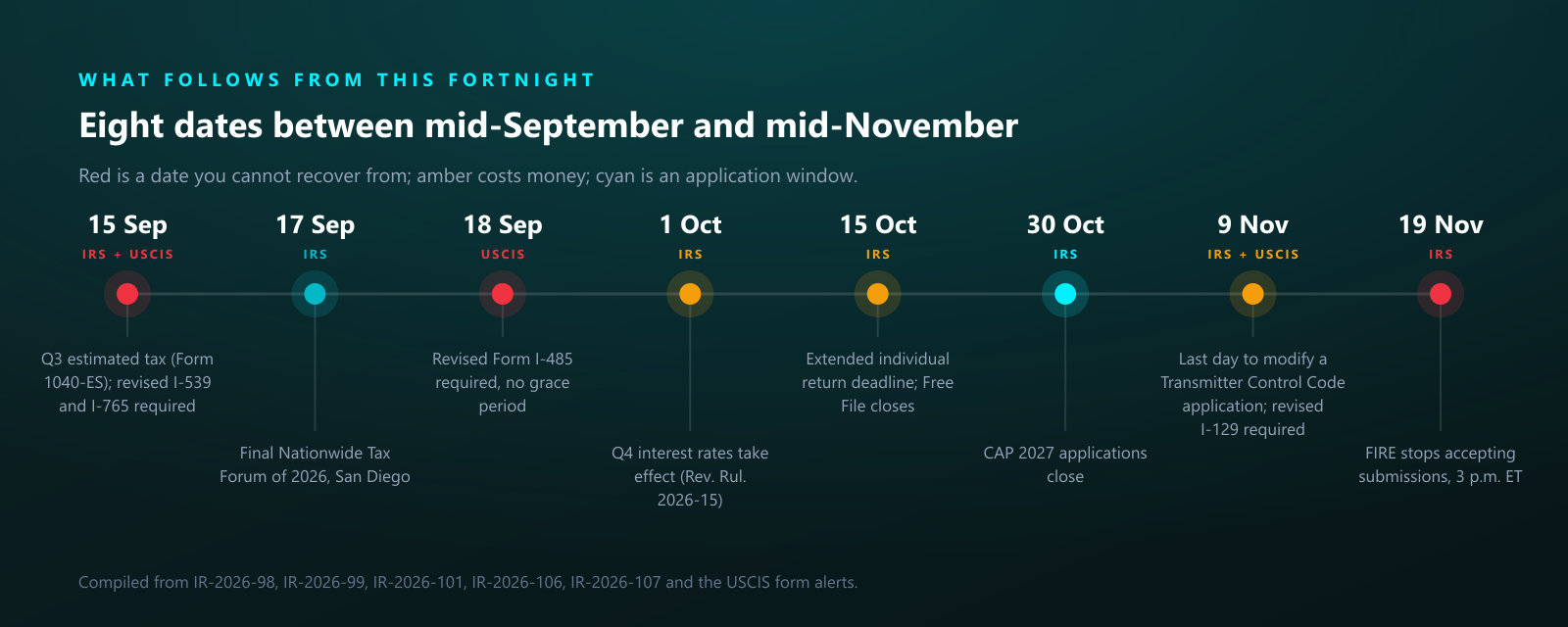
| Date | What | Who |
|---|---|---|
| 15 September 2026 | Q3 2026 estimated tax payment | Anyone paying via Form 1040-ES |
| 15 September 2026 | Revised Forms I-539 and I-765 required — no grace period | Anyone extending or changing nonimmigrant status, or requesting work authorisation |
| 15–17 September 2026 | Final IRS Nationwide Tax Forum of 2026, San Diego | Tax professionals |
| 18 September 2026 | Revised Form I-485 and Supplements A and J required — no grace period | Adjustment of status applicants |
| 1 October 2026 | Q4 interest rates take effect (Rev. Rul. 2026-15) | Everyone with a balance either way |
| 15 October 2026 | Extended individual return deadline; Free File closes | Anyone who filed Form 4868 |
| 30 October 2026 | CAP 2027 applications close | Large corporate taxpayers |
| 9 November 2026 | Last day to modify a Transmitter Control Code application; revised Form I-129 required | Information return filers; employers petitioning for nonimmigrant workers |
| 19 November 2026, 3 p.m. ET | FIRE stops accepting submissions permanently | Information return filers |
| February 2027 | CAP 2027 applicants notified | Large corporate taxpayers |
Keeping up without reading the newsroom
Three roundups in, the useful lesson from this one is that a quiet IRS fortnight is not a quiet fortnight. The agency published ten items and created one hard deadline; USCIS published two alerts and created three. If you are watching only the IRS newsroom because tax is what you do, the form editions that reject your client's filing arrive without warning.
If you handle the forms these releases keep pointing at, the BrieflyGo form catalogue keeps the current editions in one place across both agencies, and the tax calendar tracks the deadlines above.
Primary sources
- IR-2026-109 — Direct Pay offers free, easy way to pay taxes.
- IR-2026-108 — Notice on the 45Z Clean Fuel Production Tax Credit.
- IR-2026-107 — IRS accepting applicants for the 2027 Compliance Assurance Process.
- IR-2026-106 — Security Summit: strengthen defenses against tax identity theft.
- IR-2026-105 — National Payroll Week is time for a paycheck checkup.
- IR-2026-104 — Disaster preparedness starts with tax records.
- IR-2026-103 — Treasury, IRS move to end tax-exempt status for discriminatory practices in private schools.
- IR-2026-102 — Online services spotlight: taxpayers can get more done online.
- Tax Tip 2026-68 — Taxpayers have the right to retain representation.
- Tax Tip 2026-67 — How taxpayers can reconstruct records after a disaster.
- Tax Tip 2026-66 — What taxpayers should know about IRS third party authorizations.
- USCIS — New editions of Form I-539 and Form I-765, new edition of Form I-485, and the forms updates page for the 09/09/26 editions of Form I-129 and Form G-1055.
- Background — the IRS newsroom, the USCIS alerts page, and our roundups of 1–15 August 2026 and 16–27 August 2026.
Figures and dates above are transcribed from the IRS and USCIS releases cited. Guidance in proposed form can change before it is finalised, and none of it substitutes for advice on your own facts. Verify against the release itself before acting, and speak to a qualified tax professional or immigration attorney.
Share this article
Summarize with AI(opens AI chat with article URL · Gemini: prompt copied to clipboard)
BrieflyGo AI
Don't sign before you know what you're signing.
Upload any contract — NDA, SOW, lease, or employment agreement — and get an instant AI risk report with clause-by-clause explanations.
Key terms in this article
Glossary
heirs
Property LawThe people legally entitled to inherit a deceased person's property when no valid will directs it elsewhere are that person's heirs. State intestacy statutes fix who qualifies — spouse first, then children, parents, and …
Full definition →
first refusal
Contract LawFirst refusal dictates that a party must first offer an opportunity to another specified party before selling or licensing something to a third party. This clause grants the designated party a right of priority, obligati…
Full definition →
Government forms in this article
Related Forms
Form W-4
Employee's Withholding Certificate
Open in Editor →
IRSForm 2848
Power of Attorney and Declaration of Representative
Open in Editor →
IRSForm 8821
Tax Information Authorization
Open in Editor →
IRSForm 4506-T
Request for Transcript of Tax Return
Open in Editor →
IRSForm 1040-ES
Estimated Tax for Individuals
Open in Editor →
IRSForm 4868
Application for Automatic Extension of Time to File
Open in Editor →
USCISForm I-485
Application to Register Permanent Residence or Adjust Status
Open in Editor →
USCISForm I-765
Application for Employment Authorization
Open in Editor →
Explore FormGuardian
Contract Types to Review
Performance Review
Performance documents can be the paper trail used to justify termination.
Learn more →
Check a Model Release Form Before You Sign
Upload a Model Release Form to spot risky clauses, payment traps, ownership issues, and negotiation pressure points before you sign.
Learn more →
Review a Cleaning Service Contract Before Signing
Upload a Cleaning Service Contract to spot risky clauses, payment traps, ownership issues, and negotiation pressure points before you sign.
Learn more →
Contract Risk Library
Common Clause Risks
Free for your first contract
Spot the risk before you sign.
BrieflyGo flags hidden liabilities, unfair clauses, and missing protections in seconds.