October 6, 2026 · 18 min read
IRS News, 12 September – 6 October 2026: A School-Choice Credit, a New IRS App, and a Form Edition a Court Took Back
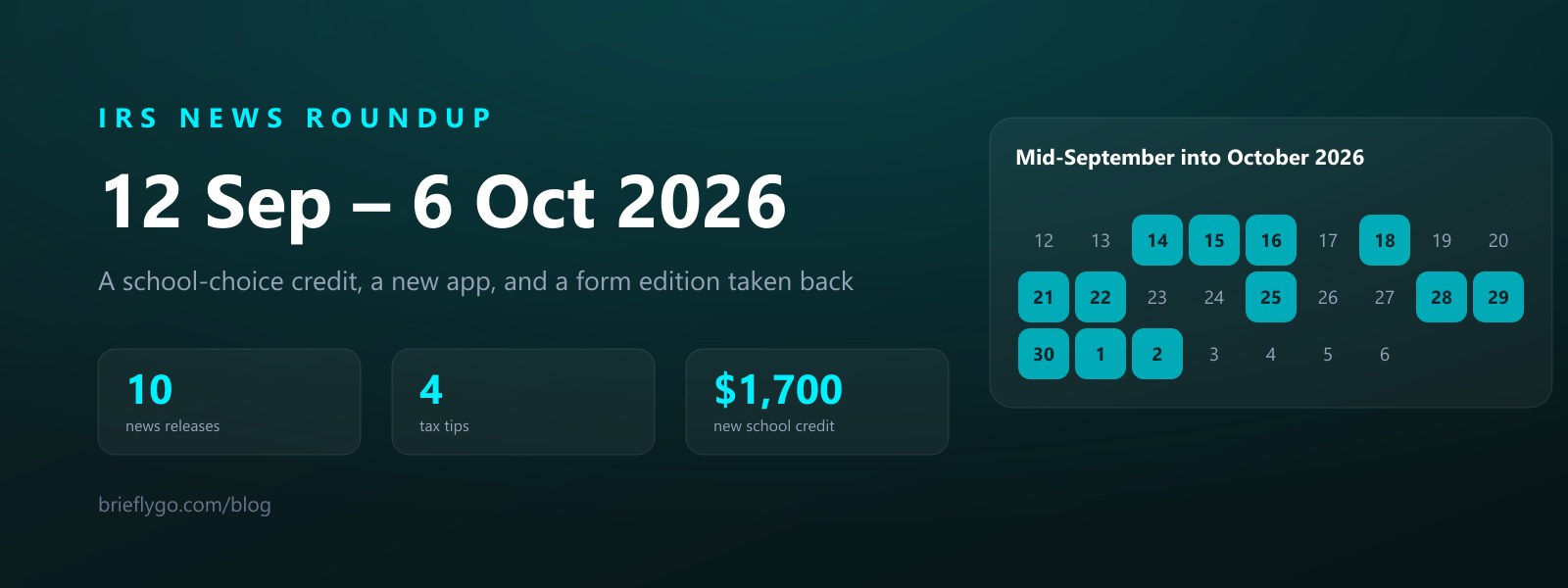
Ten IRS news releases and four tax tips from 12 September to 6 October 2026: proposed rules for the $1,700 Education Freedom Tax Credit, four-year instalments on farmland-sale tax, IRS2Go becoming the IRS app, drought and Israel relief — plus a court order that means USCIS is not accepting the new I-539 and I-765 editions.
In this article ▾
Quick answer: The IRS published ten news releases and four tax tips between 12 September and 6 October 2026. Two of them carry new rules. The first is the proposed regulations for the Education Freedom Tax Credit, a federal credit of up to $1,700 ($3,400 for joint filers) for donations to K-12 scholarship organisations, which starts on 1 January 2027. The second is a set of proposed rules that let sellers of farmland pay the tax in four annual instalments. Alongside them, IRS2Go became the IRS app, and drought and Israel relief were extended. One thing changed that matters more than any of these for anyone with an immigration filing: a federal court postponed the rule behind the new Form I-539 and I-765 editions, and USCIS is not accepting the 09/15/26 editions. That reverses what our previous roundup told you to do.
Last verified: 6 October 2026, against the IRS newsroom, the IRS guidance drop, the Internal Revenue Bulletin, Treasury press releases and USCIS. Covers items published 12 September – 6 October 2026, plus two disaster releases from 10 September that our last roundup missed. This article is educational and is not tax, legal or immigration advice. A CPA, enrolled agent, tax attorney or immigration attorney should advise on your specific facts.

The through-line: the Working Families Tax Cuts start turning into forms
The previous fortnight was mostly reminders. This window is different. The 2025 law Treasury calls the Working Families Tax Cuts is now reaching the forms people will actually file. It produced two sets of proposed regulations (school choice and farmland), final rules on car-loan interest, and draft 2026 tax forms carrying the new deductions on numbered lines.
Three newsroom items are pure security messaging. That is normal for October, which is Cybersecurity Awareness Month. The substance sits in the regulations, in guidance that came out with no press release at all, and at USCIS.
First, a correction: keep using the old Form I-539 and I-765 editions
On 11 September we wrote that USCIS would reject the old editions of Form I-539 and Form I-765 from 15 September, with no grace period, and that anything not yet posted should be rebuilt on the new edition. That was accurate on the day, and it is wrong now.
On 14 September the U.S. District Court for the District of Massachusetts, in Presidents' Alliance on Higher Education and Immigration v. DHS, postponed the fixed-admission-period final rule that the new editions implemented. USCIS's form pages now say:
"Pursuant to the Sept. 14, 2026, order, USCIS continues to accept the 08/28/24 edition of Form I-539 and 08/21/25 edition of Form I-765 and is not accepting the 09/15/26 edition of Forms I-539 and I-765."
The practitioner read: this is the opposite failure from the one we warned about. A package rebuilt on the 09/15/26 edition after our last roundup is now the one at risk. Check the edition date printed at the bottom of every page of any I-539 or I-765 still in preparation, and keep watching the form pages. A postponement order can be appealed or lifted, and the edition rule would follow it. The I-485 change of 18 September is a separate rule and was not affected: only the 09/18/26 edition is accepted.
1. The Education Freedom Tax Credit gets its rules (IR-2026-117)
On 1 October Treasury and the IRS issued proposed regulations under the new section 25F, with companion temporary regulations setting procedures for states and Scholarship Granting Organizations (SGOs). The credit rewards private donations to organisations that fund K-12 scholarships. Treasury calls it "America's first nationwide school choice program".
- Amount. An annual credit of up to $1,700 for qualifying contributions, or up to $3,400 for married couples filing jointly. It is nonrefundable.
- Start date. Contributions from 1 January 2027. Taxpayers may rely on the proposed rules from that date.
- Carryforward. Unused credit carries forward for up to five years.
- States opt in. The credit works only for SGOs in participating states. Thirty have opted in so far.
- Who can be an SGO. It must be a section 501(c)(3) public charity. A safe harbour covers organisations whose activity is at least 85% scholarship-granting. Donors may generally rely on an organisation's inclusion on the IRS SGO list.
- State credits. A taxpayer-favourable ordering rule applies where someone qualifies for both a state tax credit and the federal one.
- Privacy. Unique donor numbers mean SGOs do not need to collect donors' Social Security numbers.
Treasury's own estimates for 2030 are 600–700 SGOs, more than 11 million participating taxpayers, nearly $26 billion a year in contributions and up to 2.2 million scholarships.
"The Education Freedom Tax Credit marks a new chapter in educational freedom and opportunity by establishing America's first nationwide school choice program and empowering states to give students and families more options. Thirty states have already opted in, and we encourage all 50 states to participate so every American student and family can benefit," said Treasury Secretary Scott Bessent.
The practitioner read: the question clients will ask is "can I give in December and claim it for 2026?" The answer is no. The credit applies to contributions from 1 January 2027, so a December 2026 gift is an ordinary charitable donation at best. The second question is whether their state is in. The credit follows the SGO's state participation, not the donor's goodwill, so check the IRS SGO list before the cheque, not after. Note too that the same Treasury that is launching this credit proposed, a month earlier, to strip 501(c)(3) status from schools that discriminate by race (comments close 3 November). Schools receiving SGO-funded students will be read against both rules.
2. Farmland sales: pay the tax over four years (IR-2026-115)
On 28 September Treasury and the IRS proposed regulations under section 1062. A seller of qualifying farmland to a qualified farmer can elect to pay the tax on the gain in four equal annual instalments. It applies to sales and exchanges in taxable years beginning after 4 July 2025.
- The land. It must have been in farming use for substantially all of the previous ten years, and it carries a ten-year farming-use restriction after the sale.
- The buyer. The buyer must be actively engaged in farming.
- Timing. The first instalment is due on the regular return due date for the year of sale, without regard to extensions. Each later instalment is due on the following year's regular due date.
- Entities. The rules also cover partnerships, S corporations, trusts and estates.
- Comments. Due by 30 November 2026.
"Farmers should have practical options when farmland is sold," said IRS CEO Frank J. Bisignano. "The Working Families Tax Cuts helps keep farmland in agricultural use by allowing eligible sellers to spread their tax payments over four years when qualifying property is sold to active farmers."
The practitioner read: "without regard to extensions" is the line that will catch people. A seller who habitually files on Form 4868 still owes the first 25% on the April date. The ten-year use restriction is also a covenant on the buyer's land, so it belongs in the purchase contract as well as on the tax return. Draft that clause before closing, not after.
3. IRS2Go becomes the IRS app (IR-2026-114, Tax Tip 2026-71)
On 25 September the IRS relaunched its mobile app. IRS2Go is now the "IRS app", free on the Apple App Store and Google Play, and existing users with automatic updates receive it without downloading anything. It adds secure access to selected Individual Online Account features:
- refund and amended-return status;
- balance and payments;
- selected notices;
- transcripts and account preferences;
- the Identity Protection PIN.
Business Tax Account and Tax Pro Account stay on IRS.gov for now. Tax Tip 2026-71 followed four days later with one practical warning: install only through the verified links on IRS.gov, because look-alike apps exist.
"The new IRS app puts more services at taxpayers' fingertips," said Bisignano. "It advances our digital-first agenda to meet taxpayers how and where they choose to interact with the IRS, whether at home or on the go. Our goal is to make IRS services easy to access and more consistent across all of our platforms."
The practitioner read: the IP PIN in a phone app is the quiet win. It is the protection we argued clients should get last time, and the friction was always "I can't find it in January." It is still the taxpayer's job, not yours, but it is now one tap away instead of a sign-in on a desktop.
4. Drought relief for livestock sellers extended (IR-2026-110)
Notice 2026-54 lists the areas that qualify for extended replacement periods. They cover 49 states, the District of Columbia, Puerto Rico and other areas with exceptional, extreme or severe drought in any week between 1 September 2025 and 31 August 2026.
- Livestock covered. Livestock held for draft, dairy or breeding qualifies. Livestock held for slaughter or sporting purposes, and poultry, do not.
- Normal rule. Livestock sold because of drought must generally be replaced within four years instead of two.
- The extension. It runs to the end of the first tax year after the first drought-free year. Sellers whose replacement period was due to expire at the end of 2026 now have until the end of their next tax year.
"Large swaths of the United States continue to experience drought conditions, distressing hard-working American farmers and ranchers," said Bisignano. "By extending relief for those who sell or exchange livestock, the IRS is providing much needed support to those who feed our nation."
5. Relief elsewhere: Israel, Hawaii County and the Oglala Sioux Tribe
Israel (IR-2026-116, Notice 2026-63, 30 September). Return and payment deadlines falling between 30 September 2026 and 30 September 2027 are postponed for affected taxpayers in Israel, the West Bank and Gaza. Together with the three earlier notices, the relief runs from 7 October 2023 to 30 September 2027. The IRS applies it automatically where a previously filed return shows an address in the covered area. Anyone else who qualifies should call 866-562-5227 (267-941-1000 from outside the US).
Two disaster releases from 10 September we missed last time. Both postpone deadlines to 1 February 2027:
- Hawaii County earthquake (HI-2026-03, FEMA 4936-DR). It also covers the quarterly payroll and excise returns due 31 July and 2 November 2026. 2025 extension filers have until 1 February to file, but payments that were due 15 April 2026 are not postponed.
- Oglala Sioux Tribe storms and flooding (SD-2026-02, FEMA 4941-DR). Covers storms beginning 2 June 2026.
Both releases point to Public Law 119-64, which treats a disaster postponement as an extension for the refund look-back period.
6. Security, three times over (IR-2026-111, IR-2026-112, IR-2026-119, Tax Tip 2026-72)
The summer series closes (16 September). The fifth and final "Protect Your Clients; Protect Yourself" release lists the schemes aimed at preparers right now:
- fake "new client" emails;
- phishing for EFINs, PTINs and CAF numbers;
- IRS impersonation;
- social-media "tax hacks".
It also names the IRS letters that signal identity theft: 5071C, 4883C and 5747C. Victims file Form 14039, and preparers should report a breach to their IRS Stakeholder Liaison. Tax Tip 2026-72 (1 October) recaps the series and repeats that a Written Information Security Plan is a legal requirement, with Publication 5708 as the template.
Fake tribal tax credits (18 September). "Tribal Tax Credits", "Native American Tax Credits" and "Sovereign Tribal Tax Credits" do not exist under federal law. Promoters misuse genuine programmes to sell them:
- the section 45D New Markets Tax Credit;
- transferable clean-energy credits;
- claimed Treasury or Interior agreements and executive orders.
The red flags are deep discounts, "limited supply", unpublished agreements, legal opinions nobody can verify and non-disclosure agreements. Report promoters on Form 14242.
Cybersecurity Awareness Month (2 October). The usual list: strong passwords, multifactor authentication, updates and secure networks. One line is worth repeating to clients: the IRS makes first contact by post, and never by social-media direct message.
The practitioner read: the tribal-credit release is the one to forward. It is aimed at buyers, not promoters. The pitch is a credit sold at a discount, and the only party who can lose money on a credit that does not exist is the person who bought it. A legal opinion you are not allowed to verify is not a legal opinion.
7. The smaller items
- Tax Tip 2026-69 (14 September): estimated tax is not just for the self-employed. Anyone expecting to owe $1,000 or more may need to pay Form 1040-ES estimates on interest, dividends, capital gains, rents, royalties, prizes or alimony. The next payment after 15 September is due 15 January 2027.
- Tax Tip 2026-70 (22 September): family caregivers. A caregiver is generally the employee of the person cared for. There are exceptions for a spouse, a child under 21, a parent and workers under 18, but Form W-2 reporting can still apply. Publication 926, Table 1, is the decision table. A caregiver running a care business pays self-employment tax instead.
- IR-2026-113 (21 September): Nationwide Tax Forums. Nearly 13,000 attendees across five cities. 1,165 cases were resolved on site. Sessions covered no tax on tips and overtime and the 2027 filing season.
- IR-2026-118 (1 October): volunteers wanted. In 2026 more than 84,500 VITA and TCE volunteers prepared nearly 2.9 million free returns at about 9,000 sites. Sign-up runs October to January.
Guidance that came without a press release
Several pieces of guidance landed in the window with no newsroom announcement. These are the ones likely to reach a client file:
| Item | What it does | Who should care |
|---|---|---|
| T.D. 10054 (IRB 2026-39) | Final regulations on the new deduction for qualified passenger vehicle loan interest (up to $10,000) and on reporting by lenders receiving $600 or more of that interest. Effective 9 November 2026 | Car buyers; auto lenders |
| Notice 2026-60 | 2026–2027 per diem rates from 1 October: high-low rates of $329 (high-cost) and $230 (other CONUS); meal portions $86 and $74; incidentals-only $5 a day | Employers reimbursing travel |
| Rev. Rul. 2026-19 | October 2026 applicable federal rates: short-term 4.25%, mid-term 4.61% (annual) | Family loans, instalment sales |
| Notice 2026-62 and Rev. Rul. 2026-20 | Potentially abusive investment-fund strategies, including section 351 transfers to new ETFs followed by redemptions. Comments by 28 October 2026 | Fund sponsors and their investors |
| Notice 2026-55 | Requests comments on Opportunity Zone issues after the 2025 law. Comments by 23 November 2026 | OZ funds and investors |
| Notice 2026-61 | Extends section 871(m) phase-in relief by two years, through 2029 | Withholding agents on equity derivatives |
| Notice 2026-52 | Extends failure-to-deposit penalty relief for the remittance transfer tax (Form 720) until final regulations apply | Remittance transfer providers |
| Notice 2026-58 | Declares 71 older items of IRB guidance obsolete under the deregulation executive orders | Anyone citing older notices |
The 2026 forms take shape
The draft 2026 Form 1040, posted 17 September, is the first look at how the new law will sit on the return:
- Line 12e: standard deduction of $16,100 (single or married filing separately), $32,200 (joint) and $24,150 (head of household).
- Line 12f: a charitable contribution deduction for non-itemizers.
- Line 13a: additional deductions carried from Schedule 1-A, the schedule for the tips, overtime, car-loan interest and senior deductions.
- Line 32b: an amount from the new Schedule 3-A. This connects to the proposal that the refundable portion of certain credits counts as a "Federal public benefit".
The draft 2027 Form W-2 (posted 30 September) splits box 14 into 14a "Other", 14b "Treasury Tipped Occupation Code(s)" and a new 14c.
Drafts of Forms 1040-SR, 1040-NR, 1040-X, 1099-R, 1099-DA and W-2c also appeared, along with Publication 509, the 2027 tax calendars.
The practitioner read: drafts change, and none of these should be filed. They are still the best preview of what to collect from clients now. Line 12f means non-itemizers' 2026 cash donations matter again, so ask for receipts this year rather than reconstructing them in March. Line 13a means the Schedule 1-A deductions depend on figures an employer or lender reports, so a missing figure on a W-2 or lender statement becomes a missing deduction.
Treasury: Pillar Two and Trump Accounts
Revised GloBE Information Return (11 September). Treasury welcomed an OECD revision to the return that adds a field for US-headquartered groups to elect the "side-by-side" safe harbour. The election exempts them from Pillar Two's income inclusion rule and undertaxed profits rule and brings reporting exemptions with it. It also protects substance-based incentives such as the US R&D credit.
Trump Accounts (1 October). Treasury completed automatic enrolment: every eligible child under 18 with a valid Social Security number now has an account. A parent or guardian must claim it through the official Trump Accounts app to manage it and receive the $1,000 seed contribution.
"Millions of children have already enrolled in Trump Accounts. With automatic enrollment, over 60 million more eligible children now have an account ready to be claimed," said Bessent.
The practitioner read: "ready to be claimed" is the operative phrase. The account exists, but the seed money does not reach the child until a parent acts. That makes it a scammer's dream, so expect fake "claim your child's $1,000" messages. Point families to the official app store listing and nothing else.
Beyond the IRS: USCIS fees and filing addresses
Apart from the I-539 and I-765 reversal above, four immigration changes fall in or just after the window. Each is enforced by rejecting the filing, not by correcting it.
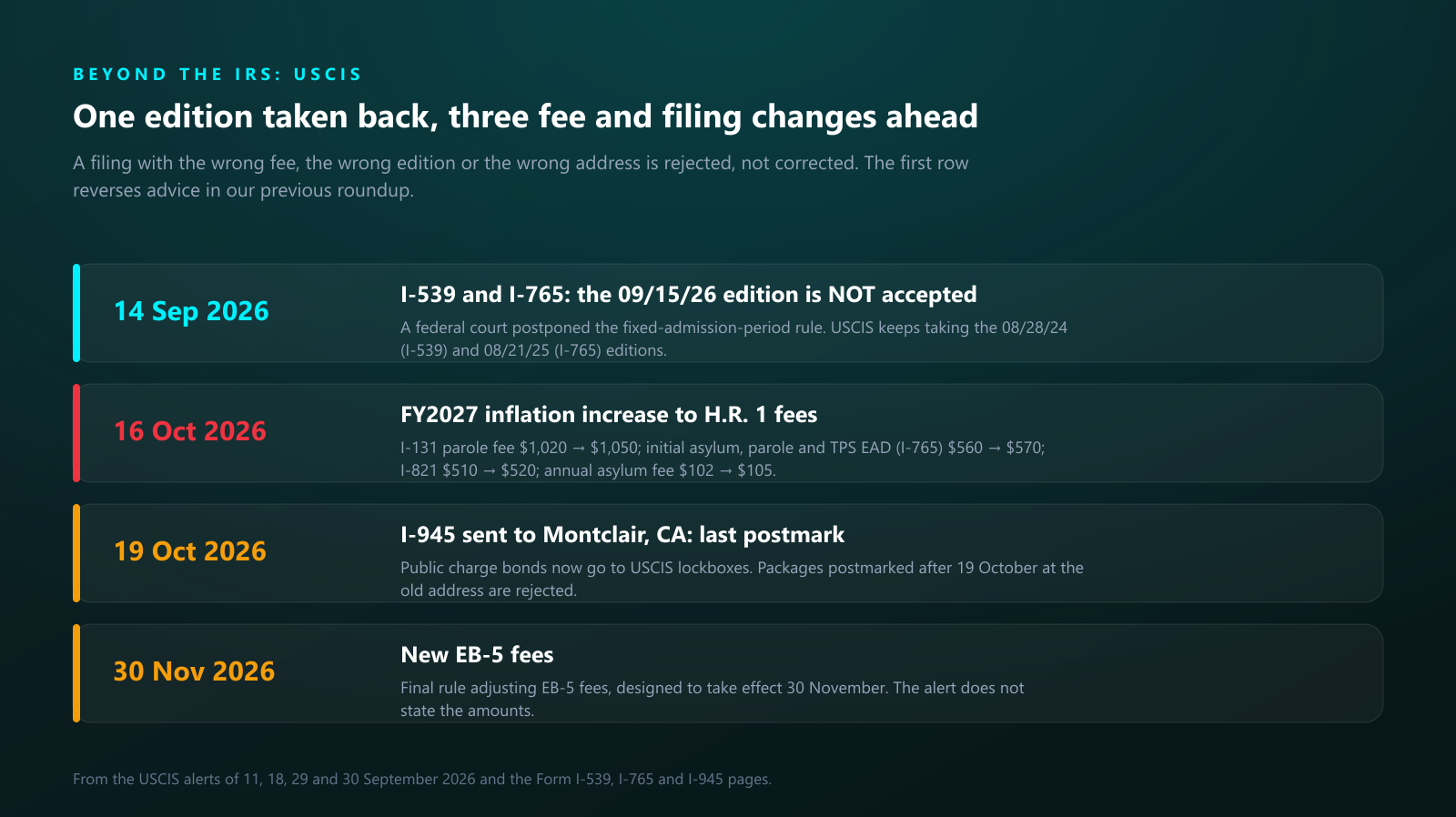
| Fee (H.R. 1) | Before 16 October | From 16 October 2026 |
|---|---|---|
| Form I-131 immigration parole fee | $1,020 | $1,050 |
| Form I-765, initial EAD for asylum applicants, parolees and TPS | $560 | $570 |
| Form I-821, Temporary Protected Status | $510 | $520 |
| Annual asylum application fee | $102 | $105 |
- Form I-945 (public charge bond) has moved to USCIS lockboxes. Packages sent to the old Montclair, California address are accepted only if postmarked on or before 19 October 2026.
- EB-5 fees. A final rule adjusts them, "designed to go into effect on Nov. 30, 2026". The alert does not give the amounts, so check the Federal Register rule before filing.
- H-2B cap. The cap for the first half of FY2027 was reached. The final receipt date was 4 September.
- Form G-1055. A 10/01/26 edition of the fee schedule adds the FY2027 fee for EOIR-29.
The practitioner read: 16 October is a postmark date, and the increases are small. That combination produces rejections: a $560 cheque written in early October and posted on the 16th is $10 short and comes back. For the four fees above, write the cheque for the new amount on anything that might be posted on or after the 16th.
What to actually do, by who you are
| If you are… | Do this | By when |
|---|---|---|
| Filing I-539 or I-765 | Use the 08/28/24 (I-539) or 08/21/25 (I-765) edition. The 09/15/26 edition is not accepted | Now, until USCIS says otherwise |
| Paying an I-131 parole, initial EAD, I-821 or asylum fee | Pay the new amount on anything posted on or after 16 October | 16 Oct 2026 |
| On a 2025 extension | File the return. 15 October is the last day | 15 Oct 2026 |
| Planning to fund private-school scholarships | Wait until 2027 for the credit, and check that the SGO's state has opted in | Contributions from 1 Jan 2027 |
| Selling farmland to a working farmer | Put the ten-year use restriction in the contract; budget the first 25% for the unextended due date | Comments on the rules close 30 Nov 2026 |
| A rancher who sold livestock because of drought | Check Notice 2026-54 for your county; your replacement deadline may have moved | Before year-end |
| A tax professional | Forward the tribal-credit warning; update your WISP; point clients to the IRS app for their IP PIN | Before January |
| A parent | Claim your child's Trump Account through the official app only | Now |
| Still filing information returns on FIRE | Move to IRIS | FIRE closes 19 Nov 2026, 3 p.m. ET |
Dates that follow from this window
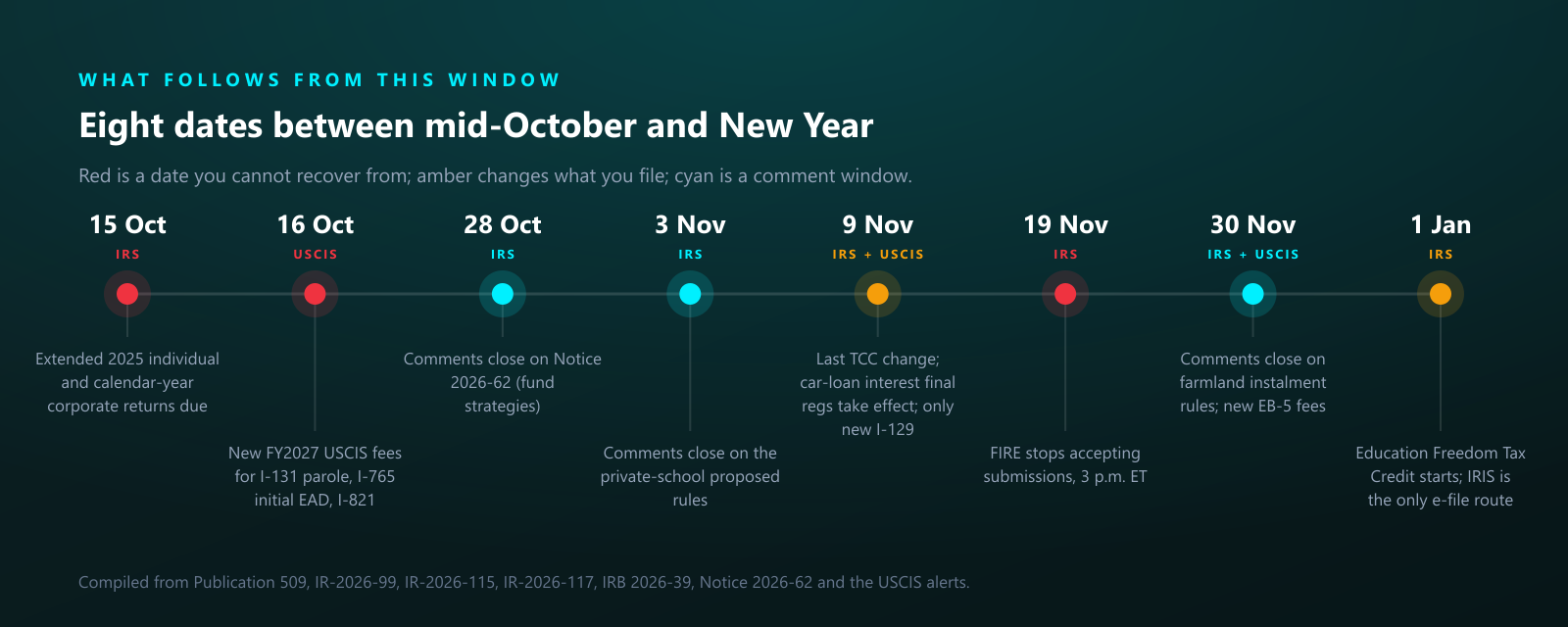
| Date | What | Who |
|---|---|---|
| 15 October 2026 | Extended 2025 individual returns and calendar-year Form 1120 due; Free File closes | Anyone who filed Form 4868; corporations |
| 16 October 2026 | New FY2027 fees for I-131 parole, initial I-765 EAD, I-821 and the asylum annual fee | Immigration filers |
| 19 October 2026 | Last postmark for Form I-945 at the Montclair address | Public charge bond obligors |
| 28 October 2026 | Comments close on Notice 2026-62 | Fund industry |
| 30 October 2026 | CAP 2027 applications close | Large corporate taxpayers |
| 2 November 2026 | Q3 Form 941 due (10 November if all deposits were on time) | Employers |
| 3 November 2026 | Comments close on the private-school proposed rules (REG-119986-25) | Tax-exempt schools |
| 9 November 2026 | Last day to change an information-return TCC application; T.D. 10054 takes effect; only the 09/09/26 edition of Form I-129 accepted | FIRE users; lenders; petitioning employers |
| 19 November 2026, 3 p.m. ET | FIRE stops accepting submissions permanently | Information-return filers |
| 23 November 2026 | Comments close on Notice 2026-55 (Opportunity Zones) | OZ investors |
| 30 November 2026 | Comments close on the farmland instalment rules; new EB-5 fees take effect | Farmland sellers; EB-5 investors |
| 1 January 2027 | Education Freedom Tax Credit begins; IRIS is the only route for information returns | Donors; information-return filers |
| 1 February 2027 | Postponed deadlines for Hawaii County and the Oglala Sioux Tribe | Disaster-area taxpayers |
What has not come out yet
As of 6 October, the IRS had not published two documents it usually releases in October:
- the 2027 inflation adjustments, which set brackets and the standard deduction;
- the 2027 retirement plan contribution limits.
If you see "2027 standard deduction" figures of $16,100, $32,200 and $24,150 circulating, those are the 2026 amounts shown on the draft 2026 Form 1040. We will cover the 2027 numbers when they are published.
Keeping up without reading the newsroom
This window had more substance than the one before it. The useful lesson, though, is the correction at the top. A form edition change announced in August, with "no grace period", was undone by a court order three weeks later. Following one agency's newsroom is not enough, and neither is reading a roundup once. Edition rules move.
The BrieflyGo form catalogue keeps the current editions in one place across both agencies. The tax calendar tracks the deadlines above.
Primary sources
- IR-2026-119: Cybersecurity Awareness Month offers simple steps to protect tax data.
- IR-2026-118: The IRS seeks community partners and volunteers to support free tax services.
- IR-2026-117: The Trump administration advances the establishment of America's first nationwide school choice program.
- IR-2026-116: New relief for eligible taxpayers affected by ongoing events in Israel, with Notice 2026-63.
- IR-2026-115: Proposed regulations on installment payments for tax on certain farmland sales.
- IR-2026-114: IRS launches new mobile app, expanding digital services for taxpayers.
- IR-2026-113: IRS wraps up successful Nationwide Tax Forums.
- IR-2026-112: IRS warns of tax credit scams targeting the tribal community.
- IR-2026-111: Security Summit closes summer series with data security reminder for tax pros.
- IR-2026-110: Extension of tax relief for farmers and ranchers affected by drought, with Notice 2026-54.
- Tax Tips 2026-69 to 2026-72: estimated taxes, family caregivers, the new IRS app and the summer series recap.
- Disaster relief: Hawaii County (HI-2026-03) and Oglala Sioux Tribe (SD-2026-02).
- Guidance: Notice 2026-60, Rev. Rul. 2026-19, Notice 2026-62, Notice 2026-55, Notice 2026-61, Notice 2026-52, Notice 2026-58, and IRB 2026-39 for T.D. 10054 and REG-119986-25.
- Draft forms: the IRS draft tax forms page.
- Treasury: revised GloBE Information Return and Trump Accounts automatic enrollment.
- USCIS: Form I-539 page (court order notice), FY2027 inflation increase for certain fees, EB-5 fee adjustment, the Form I-945 page and the forms updates page.
- Background: our roundups of 16–27 August 2026 and 28 August – 11 September 2026.
Figures and dates above are transcribed from the IRS, Treasury and USCIS releases cited. Proposed regulations and draft forms can change before they are final, and a court order can change again. None of it substitutes for advice on your own facts. Verify against the release itself before acting, and speak to a qualified tax professional or immigration attorney.
Share this article
Summarize with AI(opens AI chat with article URL · Gemini: prompt copied to clipboard)
BrieflyGo AI
Don't sign before you know what you're signing.
Upload any contract — NDA, SOW, lease, or employment agreement — and get an instant AI risk report with clause-by-clause explanations.
Key terms in this article
Glossary
heirs
Property LawThe people legally entitled to inherit a deceased person's property when no valid will directs it elsewhere are that person's heirs. State intestacy statutes fix who qualifies — spouse first, then children, parents, and …
Full definition →
first refusal
Contract LawFirst refusal dictates that a party must first offer an opportunity to another specified party before selling or licensing something to a third party. This clause grants the designated party a right of priority, obligati…
Full definition →
Government forms in this article
Related Forms
Form 1040
U.S. Individual Income Tax Return
Open in Editor →
IRSForm W-2
Wage and Tax Statement
Open in Editor →
IRSForm 1040-ES
Estimated Tax for Individuals
Open in Editor →
IRSForm 4868
Application for Automatic Extension of Time to File
Open in Editor →
IRSForm 14039
Identity Theft Affidavit
Open in Editor →
IRSForm 14242
Report Suspected Abusive Tax Promotions or Preparers
Open in Editor →
IRSForm 941
Employer's Quarterly Federal Tax Return
Open in Editor →
USCISForm I-539
Application to Extend or Change Nonimmigrant Status
Open in Editor →
Explore FormGuardian
Contract Types to Review
Performance Review
Performance documents can be the paper trail used to justify termination.
Learn more →
Check a Model Release Form Before You Sign
Upload a Model Release Form to spot risky clauses, payment traps, ownership issues, and negotiation pressure points before you sign.
Learn more →
Check a Waiver and Release Form Before Signing
Upload a Waiver and Release Form to spot risky clauses, payment traps, ownership issues, and negotiation pressure points before you sign.
Learn more →
Contract Risk Library
Common Clause Risks
Free for your first contract
Spot the risk before you sign.
BrieflyGo flags hidden liabilities, unfair clauses, and missing protections in seconds.