
August 27, 2026 · 14 min read
IRS News, 16–27 August 2026: FIRE Shuts Down, Rates Hold, and a Report You Can Actually Verify
Ten IRS news releases and three tax tips from the second half of August 2026 — the FIRE information-return system closing for good on 19 November, a digitally authenticated Tax Compliance Report, unchanged Q4 interest rates, and proposed rules on Trump Account investments, refundable credits and business interest.
In this article ▾
Quick answer: The back half of August 2026 produced ten IRS news releases and three tax tips, and the one with a hard deadline attached is the quietest of them. FIRE — the system most information returns have been filed through for decades — closes for good at 3 p.m. ET on 19 November 2026, and tax year 2026 returns must go through IRIS instead. Everything else is guidance: three sets of proposed rules, a new digitally signed compliance report, and fourth-quarter interest rates that did not move.
Last verified: 27 August 2026, against the IRS newsroom. Covers items published 16–27 August 2026. This article is educational and is not tax or legal advice. A CPA, enrolled agent or tax attorney should advise on your specific return, entity and state rules.

The through-line: infrastructure, not policy
The first half of August was about new documents — sample rollover forms, Form 4547, a notice channel moving online. The second half is about the plumbing those documents travel through. A filing system is being switched off. A new authenticated artefact replaces a phone call to verify someone's tax standing. An entire category of settlement letters stops going out. Proposed rules arrive that determine who may receive a refund at all.
Only one item carries a date you can miss, and it is section one. The rest change how work gets done rather than when.
1. FIRE is being switched off (IR-2026-99)
On 24 August the IRS reminded filers that the Filing Information Returns Electronically (FIRE) system is retiring, and that anyone still on it must move to the Information Returns Intake System (IRIS) before the 2027 filing season. Tax year 2026 information returns — the 1099-NEC, 1099-MISC and the rest of the series you file each January — cannot be submitted through FIRE.
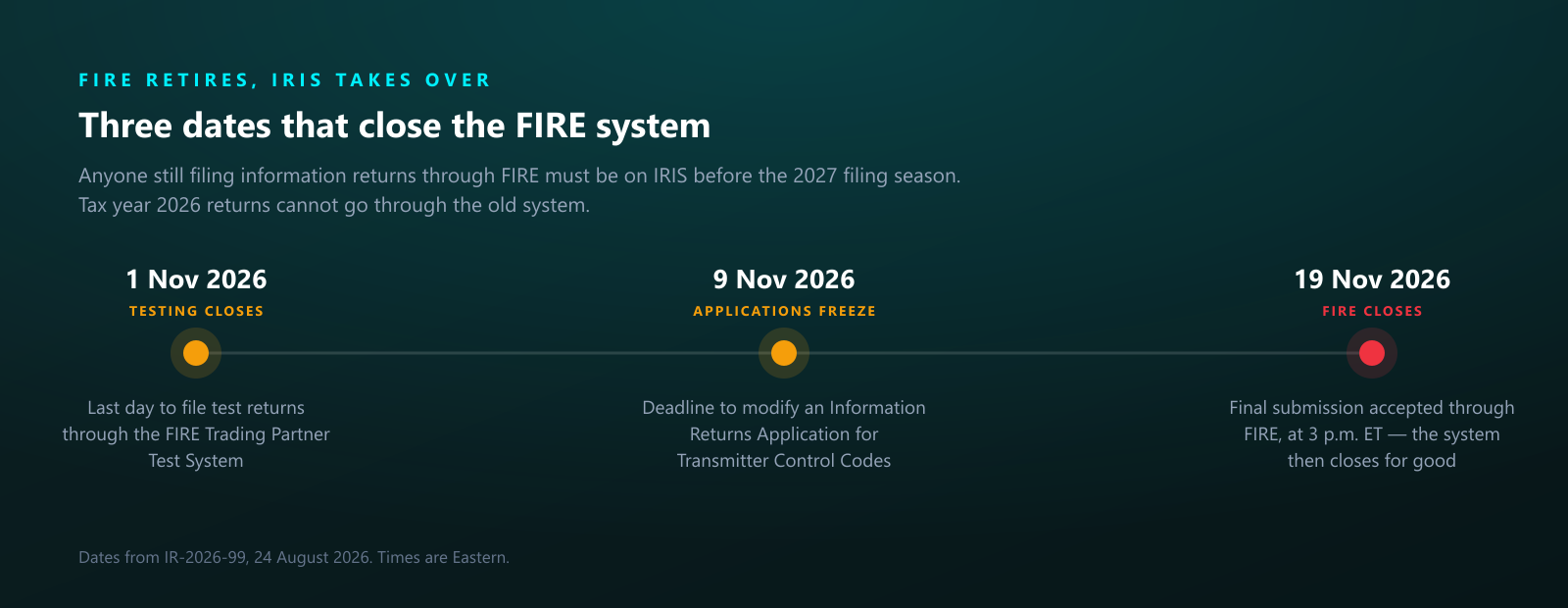
| Date | What closes |
|---|---|
| 1 November 2026 | Last day to file test returns through the FIRE Trading Partner Test System |
| 9 November 2026 | Deadline to modify an Information Returns Application for Transmitter Control Codes |
| 19 November 2026, 3 p.m. ET | Final submission accepted through FIRE |
IRIS takes returns through two channels: the IRIS Taxpayer Portal, a free web form that accepts up to 100 returns at a time manually or by CSV upload, and IRIS Application to Application for volume filers with their own software. To use either, you need an IRIS Application for Transmitter Control Codes — a different application from the FIRE one, which is exactly the trap in that 9 November date.
The practitioner read: the deadline that will actually hurt is 9 November, not 19 November. The last-submission date is visible and everyone will plan around it; the application cut-off is ten days earlier and gates whether you can file on the new system at all. A firm that discovers in December that its TCC application was never migrated has no route left for January's 1099 run. Start the IRIS application now — the IRS also runs an IRIS Working Group on the second Wednesday of each month, which is a cheap way to hear about problems before you hit them.
2. A digitally authenticated Tax Compliance Report (IR-2026-97)
On 20 August the IRS launched a Tax Compliance Report, available through Individual Online Account. It is a downloadable document a taxpayer can hand to a lender, an employer, or a benefits office as proof of where they stand with the IRS — and each one carries an IRS-issued digital certificate embedded in the file, so the recipient can verify it has not been altered.
"By providing a secure, digitally authenticated report, the IRS is making it easier for taxpayers to access and share important information while protecting privacy and data integrity," said IRS CEO Frank J. Bisignano.
The release does not frame this as replacing anything, and it is worth being precise about that: transcripts still exist and still do their jobs. Tax Tip 2026-65, published six days later, walks through the five types — tax return, tax account, record of account, wage and income, and the verification of non-filing letter — and how far back each goes. Return transcripts cover the current year plus three; account and wage-and-income transcripts go back nine. Form 4506-T still requests any of them by post.
The practitioner read: the interesting part is the certificate, not the report. A transcript emailed as a PDF has always been trivially editable, which is why lenders insist on receiving one directly. An embedded certificate moves verification from the channel to the document, and once verifiers learn to check it, the "we can only accept it if the IRS sends it to us" friction goes away. Expect adoption to lag the launch by a year while the other side of the transaction learns the report exists.
3. Interest rates hold for the fourth quarter (IR-2026-98)
Announced 21 August in Revenue Ruling 2026-15, rates for the quarter beginning 1 October 2026 are unchanged from Q3. All compound daily, and all are calculated from the federal short-term rate determined in July 2026.
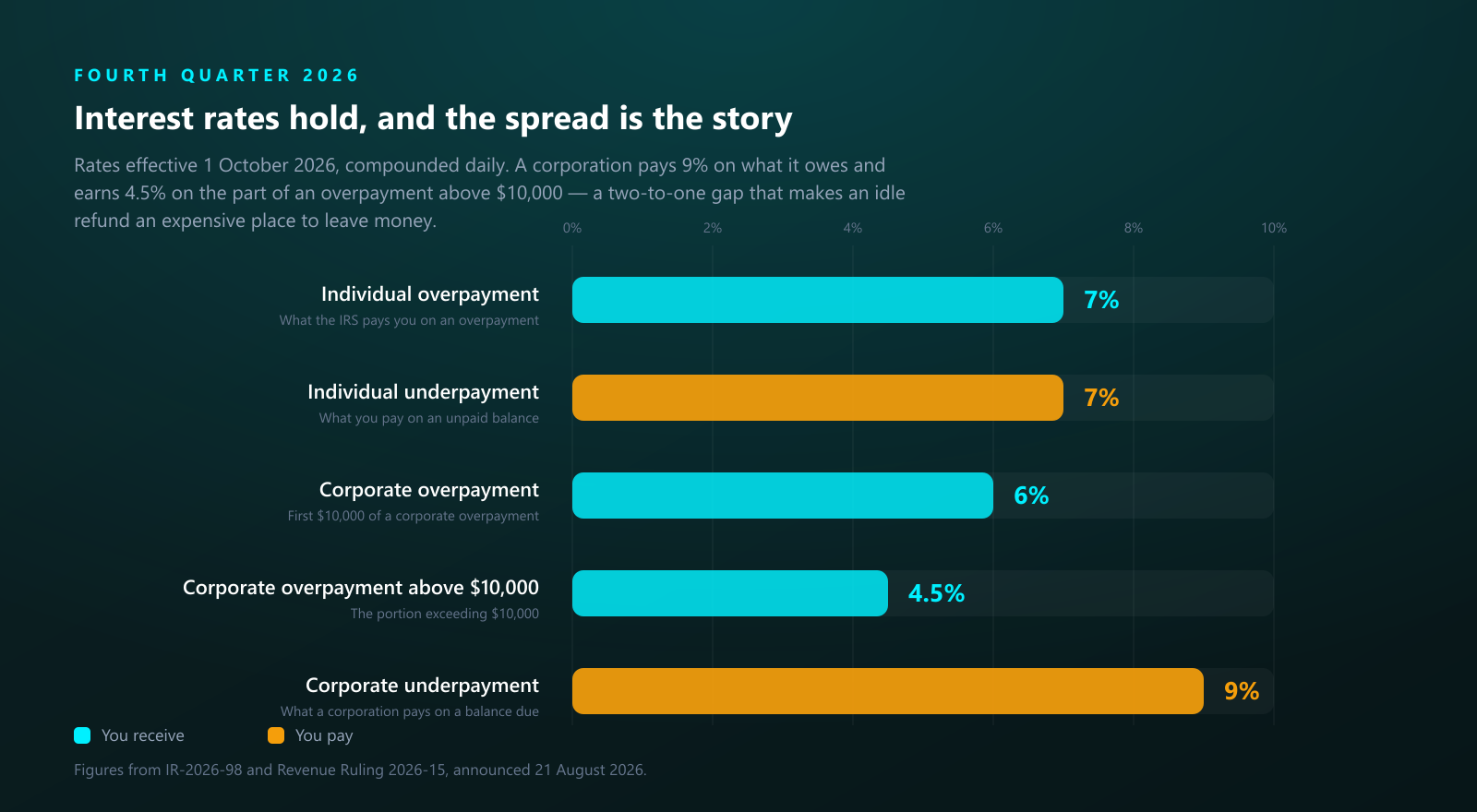
Individuals sit at 7% both ways — the same rate whether the IRS owes you or you owe the IRS. Corporations do not get that symmetry: 9% on an underpayment, 6% on an overpayment, and only 4.5% on the portion of an overpayment above $10,000.
The practitioner read: that corporate spread is a two-to-one penalty on carrying a balance, and a quiet argument against parking a large overpayment with the IRS as a convenience. Money owed to the agency compounds at double the rate money left with it earns. If a corporate client is sitting on a five-figure overpayment because it is easier than filing for a refund, the arithmetic no longer supports the convenience.
4. Trump Accounts: what the money may be invested in (IR-2026-96)
Also on 20 August, Treasury and the IRS proposed rules on eligible investments for Trump Accounts — a new type of traditional IRA. This is the companion to the employer-contribution rules issued on 11 August, and between the two the account is now largely specified.
During the growth period, funds may only go into mutual funds or ETFs that meet three tests: they track an equity index of primarily U.S. companies (the S&P 500 is the named example), they do not use leverage, and their annual fees and expenses do not exceed 0.1% of the fund balance. The growth period runs from when the beneficiary's first account is opened until 31 December of the year they turn 17; after that the restrictions fall away.
An account can be opened for any child with a Social Security number before the calendar year they turn 18. Children born between 2025 and 2028 may qualify for a $1,000 pilot contribution, elected by checkbox on Form 4547 — the form that appeared in the first half of the month. Comments are due 20 October 2026, and the rules apply to tax years beginning on or after 1 January 2026.
The proposed regulations are intended to encourage eligible participants to invest in "low-fee mutual funds and ETFs," said Bisignano.
The practitioner read: the 0.1% expense cap is the load-bearing number and it is tighter than it looks. It excludes most actively managed products outright and a fair number of index funds too. If you advise families here, the practical question is not whether to open an account but which handful of funds actually clear the cap — and that list will be short enough to check by hand.
5. Business interest expense: the FAQs were rewritten (IR-2026-94)
On 19 August the IRS issued FS-2026-14, replacing FS-2025-09 from December 2025, covering the section 163(j) limitation on deducting business interest.
The core test is unchanged. Deductible business interest cannot exceed the sum of business interest income, 30% of adjusted taxable income, and floor plan financing interest. What changed is the framing: the new fact sheet covers both the 2017 Tax Cuts and Jobs Act and the One, Big, Beautiful Bill Act amendments, deletes the Topic D CARES Act questions that no longer apply, and — the useful part — has been revised to distinguish substantive changes in law from clarifications of existing law. Reporting still runs through Form 8990.
One provision worth knowing: a taxpayer who reasonably and in good faith relies on these FAQs will not face a penalty subject to a reasonable-cause standard — including negligence and other accuracy-related penalties — to the extent that reliance produces an underpayment.
The practitioner read: "distinguishes substantive changes from clarifications" is doing real work in that sentence. A clarification applies to years already open; a substantive change does not. If you took a 163(j) position in 2024 or 2025 on the strength of the old FAQs, the new fact sheet tells you which of those positions the IRS now considers to have always been the rule — and that is a re-read worth an hour, not a skim.
6. Proposed rules on who may receive a refundable credit (IR-2026-93)
On 19 August Treasury and the IRS proposed regulations applying the Personal Responsibility and Work Opportunity Reconciliation Act of 1996 (PRWORA) to four refundable credits: the adoption credit, the child tax credit, the American opportunity credit, and the earned income tax credit.
The mechanism is narrower than the headline suggests, and the distinction matters. The proposal treats only the refunded portion — the amount exceeding tax liability — as a federal public benefit. To receive it, a taxpayer must be a U.S. citizen, U.S. national, or qualified alien at the time of filing, and must declare that status under penalty of perjury. On a joint return, only one spouse must meet the test. Taxpayers who do not meet it may still claim the non-refundable portion that offsets tax liability.
"American taxpayers should not be forced to foot the bill for benefits going to those who are barred by law from receiving them," said Treasury Secretary Scott Bessent.
The rules would apply to tax years ending after the final regulations are published. Comments and hearing requests are open.
7. Written Information Security Plans, again (IR-2026-92)
On 18 August the Security Summit returned to a theme it raised on 4 August with the phishing warning: tax professionals must have a Written Information Security Plan. This is not an IRS suggestion — the Gramm-Leach-Bliley Act makes tax and accounting firms financial institutions, and the FTC Safeguards Rule enforces the requirement.
The FTC's minimum is that a firm designates someone to coordinate the program, identifies and assesses risks to customer information, creates and regularly tests safeguards, and contracts with service providers capable of maintaining them. A WISP should concentrate on employee management and training, information systems, and detecting and managing system failures. Publication 5708 is the IRS template, aimed at smaller practices; Publications 5709, 5293 and 4557 fill in around it.
There is also a reporting clock: under the Safeguards Rule, a covered institution must report a security event affecting 500 or more people to the FTC within 30 days of discovery.
The practitioner read: the 30-day notification duty is the part small firms tend not to know about, and it runs from discovery, not from resolution. If you have a WISP that was written once and filed, the honest test is whether anyone in the office could name who coordinates it. That is the first question an examiner asks.
8. A new Office of Conservation Easements — and no more uniform settlement letters (IR-2026-95)
On 19 August the IRS established an Office of Conservation Easements, centralising expertise on the valuation, contractual and procedural issues these cases raise, and coordinating with Treasury and Chief Counsel on administrative and legislative options.
Attached to that announcement is a live procedural change: the IRS is discontinuing its uniform settlement letter program, effective immediately. The agency concluded that "standardized, unsolicited settlement letters on a rolling basis" are not suited to the range of these cases, given how much partnership agreements and insurance arrangements differ. Practically:
- Settlement offers already issued remain valid and will be processed.
- Taxpayers can still request a settlement through their assigned IRS representative under the May 13 framework.
- Individual cases may resolve on different terms depending on litigation risk.
- No new uniform settlement letters will go out.
The practitioner read: the shift is from a queue to a negotiation. Under rolling letters, waiting was a strategy — a letter would arrive eventually. It will not now. If a client has an unresolved easement matter and no offer in hand, the move is to approach the assigned representative rather than wait for the agency to open the conversation.
Also this fortnight: extension filers and the paid-leave credit
Two reminders round out the period. IR-2026-101 (26 August) and Tax Tip 2026-63 (18 August) both point extension filers at IRS Free File, open through 15 October 2026 for anyone with adjusted gross income of $89,000 or less for 2025. Above that threshold, Free File Fillable Forms is the self-prepare route. The IRS repeats the distinction that catches people every year: an extension via Form 4868 "gives taxpayers more time to file but not more time to pay" — interest and penalties have been running since April on anything unpaid.
Tax Tip 2026-64 (20 August) revisits the paid family and medical leave credit expansion from Notice 2026-28 earlier in the month, claimed on Form 8994.
Finally, IR-2026-100 (25 August) reported Bisignano meeting practitioners at the New York Nationwide Tax Forum, where the IRS put numbers on the season just finished: over 144 million returns processed, 98% of refunds delivered electronically, and average refunds up 11% year over year on the Working Families Tax Cuts.
What to actually do, by who you are
| If you are… | Do this | By when |
|---|---|---|
| Anyone filing 1099s or other information returns | Start the IRIS Application for Transmitter Control Codes; do not assume your FIRE credentials carry over | Application changes close 9 Nov 2026 |
| A tax professional | Confirm your WISP exists, names a coordinator, and has been tested — Publication 5708 is the template | Now; the FTC duty is continuous |
| A corporation with a large overpayment | Reprice leaving it with the IRS at 4.5% above $10,000 against 9% on anything you owe | Rates effective 1 Oct 2026 |
| A business claiming interest deductions | Re-read FS-2026-14 for which items it labels clarifications rather than changes | Before the next Form 8990 |
| A parent considering a Trump Account | Shortlist index funds at or under 0.1% annual expenses; check Form 4547 pilot eligibility | Comments close 20 Oct 2026 |
| An extension filer | File now via Free File if AGI ≤ $89,000 — pay anything owed immediately regardless | 15 Oct 2026 |
| Holding an unresolved easement matter | Approach your assigned IRS representative; no further uniform letters are coming | Now |
Dates that follow from this fortnight
| Date | What | Who |
|---|---|---|
| 15 September 2026 | Q3 2026 estimated tax payment | Anyone paying via Form 1040-ES |
| 1 October 2026 | Q4 interest rates take effect (Rev. Rul. 2026-15) | Everyone with a balance either way |
| 15 October 2026 | Extended individual return deadline; Free File closes | Anyone who filed Form 4868 |
| 20 October 2026 | Comments due on Trump Account investment rules | Fund providers, benefits advisers |
| 1 November 2026 | FIRE test system closes | Information return filers |
| 9 November 2026 | Last day to modify a Transmitter Control Code application | Information return filers |
| 19 November 2026, 3 p.m. ET | FIRE stops accepting submissions permanently | Information return filers |
Keeping up without reading the newsroom
Two roundups in, the pattern is clear enough to plan around. The IRS publishes most substantive guidance mid-week, proposed regulations arrive with a comment window roughly two months out, and the items that carry real deadlines are rarely the ones with the most quotable headline. A fortnightly skim of the release list, filtered for anything naming a date or a form number, catches almost everything that will cost money to miss.
If you handle the forms these releases keep pointing at, the BrieflyGo form catalogue keeps the current versions in one place, and the tax calendar tracks the deadlines above.
Primary sources
- IR-2026-101 — Extension filers can use IRS Free File this summer.
- IR-2026-100 — IRS CEO meets with tax professionals at NY tax forum.
- IR-2026-99 — Information return e-file system transitioning to a new platform.
- IR-2026-98 — Interest rates remain the same for the fourth quarter of 2026 (Revenue Ruling 2026-15).
- IR-2026-97 — IRS launches digitally authenticated Tax Compliance Report.
- IR-2026-96 — Proposed regulations on eligible investments for Trump Accounts.
- IR-2026-95 — IRS establishes Office of Conservation Easements and transitions settlement process.
- IR-2026-94 — IRS updates FAQs about the limitation on the deduction for business interest expense, and the fact sheet FS-2026-14.
- IR-2026-93 — Proposed rules on eligibility for refundable tax credits.
- IR-2026-92 — Security Summit on Written Information Security Plans, and Publication 5708.
- Tax Tip 2026-65 — Tax transcripts: know the different types and how to get them.
- Tax Tip 2026-64 — Enhancements to the paid family and medical leave tax credit.
- Tax Tip 2026-63 — The top 5 tips for extension filers.
- Background — the IRS newsroom and our roundup of 1–15 August 2026.
Figures and dates above are transcribed from the IRS releases cited. Guidance in proposed form can change before it is finalised, and none of it substitutes for advice on your own facts. Verify against the release itself before acting, and speak to a qualified tax professional.
Share this article
Summarize with AI(opens AI chat with article URL · Gemini: prompt copied to clipboard)
BrieflyGo AI
Don't sign before you know what you're signing.
Upload any contract — NDA, SOW, lease, or employment agreement — and get an instant AI risk report with clause-by-clause explanations.
Key terms in this article
Glossary
heirs
Property LawThe people legally entitled to inherit a deceased person's property when no valid will directs it elsewhere are that person's heirs. State intestacy statutes fix who qualifies — spouse first, then children, parents, and …
Full definition →
first refusal
Contract LawFirst refusal dictates that a party must first offer an opportunity to another specified party before selling or licensing something to a third party. This clause grants the designated party a right of priority, obligati…
Full definition →
Government forms in this article
Related Forms
Form 1099-NEC
Nonemployee Compensation
Open in Editor →
IRSForm 1099-MISC
Miscellaneous Information
Open in Editor →
IRSForm 8990
Limitation on Business Interest Expense Under Section 163(j)
Open in Editor →
IRSForm 4868
Application for Automatic Extension of Time to File
Open in Editor →
IRSForm 4506-T
Request for Transcript of Tax Return
Open in Editor →
IRSForm 1040-ES
Estimated Tax for Individuals
Open in Editor →
IRSForm 8994
Employer Credit for Paid Family and Medical Leave
Open in Editor →
Explore FormGuardian
Contract Types to Review
Shareholders' Agreement
Your equity is worth only what the shareholders agreement lets you do with it.
Learn more →
NDA
Signing an NDA is easy. Understanding what you just agreed never to say is harder.
Learn more →
SOW (Statement of Work)
Vague scope = cost overruns. BrieflyGo finds the gaps before they find you.
Learn more →
Contract Risk Library
Common Clause Risks
Free for your first contract
Spot the risk before you sign.
BrieflyGo flags hidden liabilities, unfair clauses, and missing protections in seconds.