
August 15, 2026 · 12 min read
IRS News, 1–15 August 2026: New Forms, Digital Notices, and the W-2 Change That Starts This Year
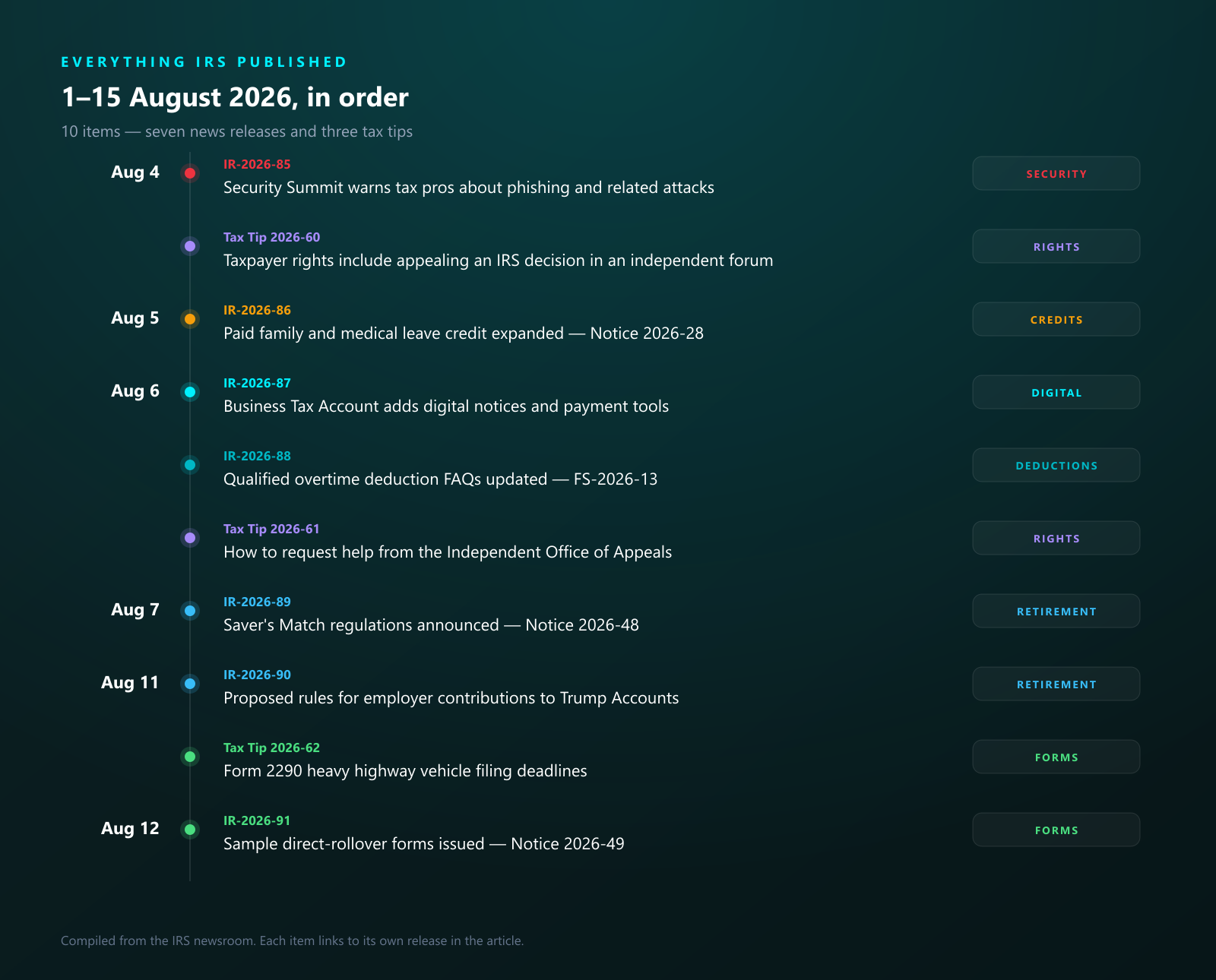
Seven IRS news releases and three tax tips from the first half of August 2026 — sample rollover forms, Form 4547, Business Tax Account digital notices, the paid-leave credit expansion, Saver’s Match, and the overtime reporting rule that becomes mandatory for tax year 2026.
In this article ▾
Quick answer: In the first half of August 2026 the IRS published seven news releases and three tax tips, and almost all of them were about paperwork. Treasury issued sample direct-rollover forms, proposed rules that come with a new Form 4547, expanded Business Tax Account so notices arrive on screen instead of in the post, and updated the overtime-deduction FAQs — where the buried headline is that separate reporting of qualified overtime on Forms W-2 and 1099 becomes mandatory for tax year 2026, after being optional for 2025.
Last verified: 15 August 2026, against the IRS newsroom. Covers items published 1–15 August 2026. This article is educational and is not tax or legal advice. A CPA, enrolled agent or tax attorney should advise on your specific return, entity and state rules.
The through-line: a fortnight about documents
Tax news is usually about rates and thresholds. This fortnight was not. Read the seven releases together and the pattern is administrative: three new or newly-sampled documents (rollover forms, Form 4547, a written Trump Account plan), one channel change (notices moving into Business Tax Account), one reporting change that starts with the year you are already in, and one warning aimed squarely at the people who hold everyone else's documents.
If you only have five minutes, the reporting change is the one that will cost money to get wrong, and it is section four below.
1. Sample direct-rollover forms, at last (IR-2026-91)
On 12 August, Treasury and the IRS issued Notice 2026-49, providing sample forms and proposed procedures for direct rollovers — satisfying a mandate that has been sitting in section 324 of the SECURE 2.0 Act since it passed. The samples cover rollovers between retirement plans, and between a plan and an IRA. They do not cover IRA-to-IRA transfers.
"The sample forms will make compliance simpler and easier for both plan participants and administrators," said IRS CEO Frank J. Bisignano.
Two things matter for anyone administering a plan. First, use of the sample forms and proposed procedures is optional — this is a safe harbour, not a mandate, so an existing rollover packet does not become invalid on 12 August. Second, the comment window runs to 23 October 2026, which is the moment to raise anything impractical before the procedures firm up.
The practitioner read: optional guidance of this kind tends to become the de facto standard within a cycle or two, because it is the version an auditor recognises. If you are rebuilding rollover paperwork anyway, rebuild it against the sample rather than against your 2019 template.
2. A new form arrives: Form 4547 and Trump Account contribution programs (IR-2026-90)
On 11 August the agencies issued proposed regulations covering employer contributions to Trump Accounts, the accounts introduced under the Working Families Tax Cuts. We covered the launch of the accounts themselves in an earlier piece on the new regulations; this release is about the employer side.
The mechanics an employer needs:
- Employers may contribute up to $2,500 a year per employee or dependent.
- A pilot provides $1,000 contributions for children born 2025–2028.
- A contribution program must be "a separate written plan of an employer for the exclusive benefit of employees" — so this is a plan document to draft, not a payroll switch to flip.
- Elections run on Form 4547, Trump Account Election.
- The proposals also address nondiscrimination requirements, for both Trump Account programs and dependent care assistance programs.
Comments are due 25 September 2026, with a public hearing on 15 October 2026 and hearing requests by 13 October.
3. Notices move onto the screen: Business Tax Account (IR-2026-87)
The 6 August release expanded Business Tax Account (BTA), the IRS's online portal for entities rather than individuals. Eligibility now reaches a fairly wide set: sole proprietors with an EIN; individual partners and shareholders holding a Schedule K-1; S and C corporations; federal, state, local and tribal governments; and tax-exempt organisations.
"By expanding online self-service options, BTA makes it easier for eligible businesses and organizations to manage their federal tax obligations securely and conveniently online," said Bisignano.
The part worth acting on is the digital notices. Correspondence that used to arrive only as paper now appears in the account, including CP081B (a potential refund about to expire), CP211A (extension approved), CP134R (a deposit discrepancy refund) and CP575 (the EIN confirmation that everyone loses and every bank asks for). Alongside that: viewing and paying balances from a bank account, scheduling payments up to a year ahead, storing multiple bank accounts, making Offer in Compromise payments, and tracking a payment-plan balance.
The practitioner read: the CP575 alone justifies the signup. It is the document new banks, payment processors and landlords ask for, the IRS does not reissue it, and until now the replacement route was a CP575 substitute letter and a wait. A business that can pull it from a portal has removed a recurring administrative dead end.
4. The overtime deduction — and the W-2 change that starts this year (IR-2026-88)
Also on 6 August, the IRS updated its FAQs on the deduction for qualified overtime compensation, publishing Fact Sheet FS-2026-13, which revises the FS-2026-01 issued in January. The deduction covers overtime required under section 7 of the Fair Labor Standards Act, and is available whether you itemise or take the standard deduction.
It is one of four new individual deductions running for tax years 2025 through 2028, and they are easier to keep straight side by side:
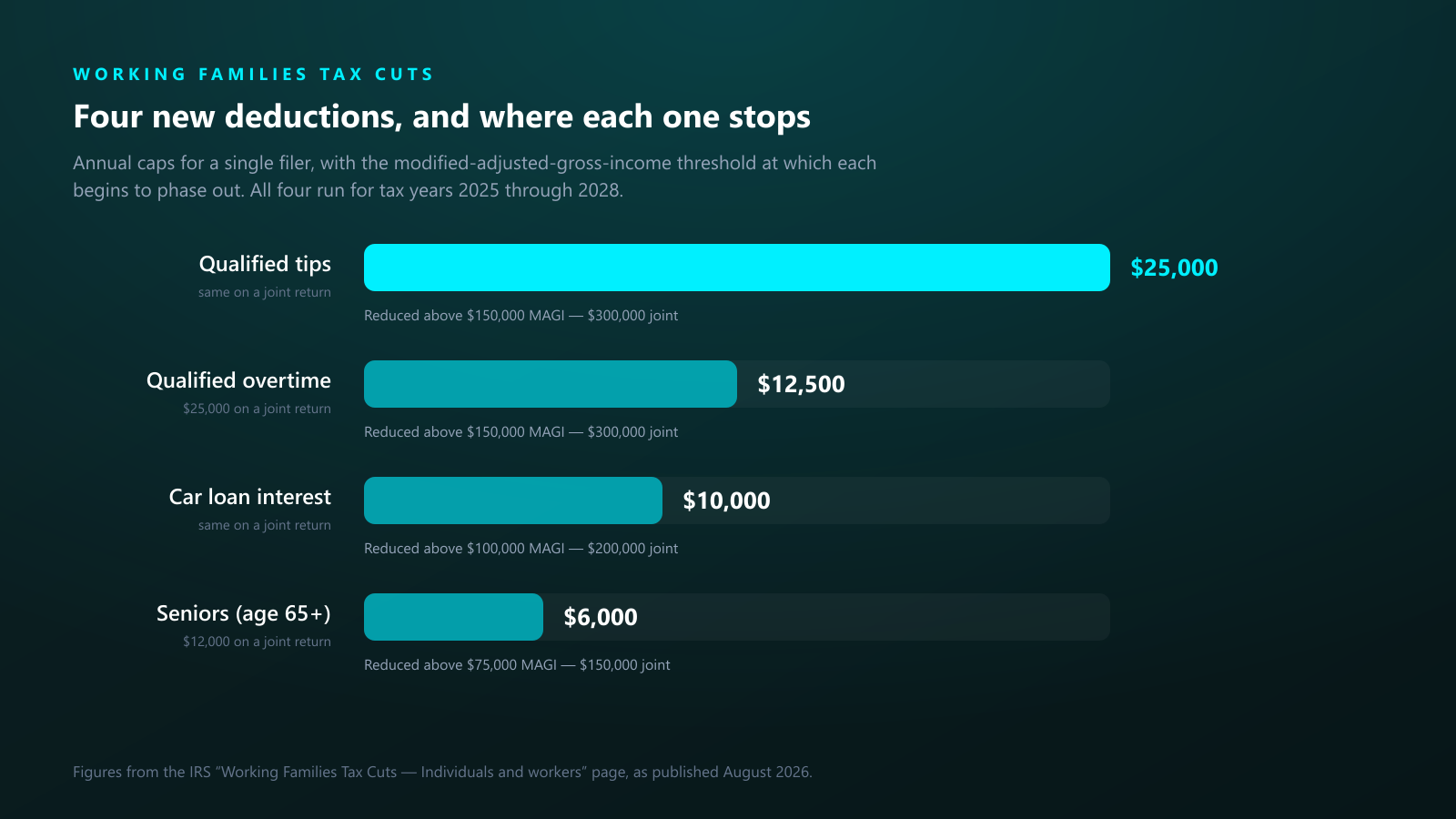
Now the buried headline. The reporting rule is not the same for 2025 and 2026:
| Tax year | Separate reporting of qualified overtime | What that means for you |
|---|---|---|
| 2025 | Not required on Forms W-2, 1099-NEC or 1099-MISC | Employees may have to substantiate the figure themselves; Treasury and the IRS said they would provide transition relief |
| 2026 and later | Required — employers and other payers must report it separately | Payroll has to identify FLSA-qualifying overtime as a distinct amount for the year already running |
The practitioner read: this is the item on the list with a real cost of delay. An employer discovering in January 2027 that their payroll system never separated FLSA overtime from other premium pay is looking at a reconstruction across twelve months of payroll, not a configuration change. August is the right month to check what your provider is doing, because there are still four months of the year left to fix it in.
5. Paid family and medical leave, made permanent and wider (IR-2026-86)
On 5 August, Notice 2026-28 set out guidance on the permanent expansion of the employer credit for paid family and medical leave — the section 45S credit, worth 12.5% to 25% of wages paid to qualifying employees for up to 12 weeks of leave a year, and claimed on Form 8994.
"Hardworking Americans should not have to choose between caring for a loved one and earning a paycheck," said Treasury Secretary Scott Bessent.
What changes from 2026:
- Eligibility extends to employees with six months of service, and to part-time employees averaging 20 or more hours a week.
- The credit can now cover insurance premiums for a PFML policy, not only wages paid during leave.
- Employers may count leave under a state or local mandate toward eligibility without counting it toward the credit calculation.
- There is a method for allocating qualifying premiums, and an election between the premium-based and wage-based approaches.
The premium route is the genuinely new option: an employer who buys PFML insurance rather than self-funding leave was previously getting little from this credit.
6. Saver's Match: lands in 2027, decided in 2026 (IR-2026-89)
On 7 August, Notice 2026-48 announced an intent to propose regulations for the Saver's Match, implementing Executive Order 14403. The programme pays a federal matching contribution — up to 50% of the first $2,000 of qualifying retirement contributions, so a maximum of $1,000 a year — directly into an eligible taxpayer's retirement account. The IRS describes it as replacing the Saver's Credit, and it was enacted under SECURE 2.0.
"The Saver's Match makes saving easier and more rewarding by providing a direct federal contribution to an eligible taxpayer's retirement account," said Bisignano.
It begins with the 2027 tax year, with payments following in 2028. Comments close 5 October 2026. A credit that arrives as money in an account rather than as a line on a return is an administrative problem for plan providers, and that is exactly what the comment period is for.
7. Phishing aimed at the people who hold your documents (IR-2026-85)
Week two of the Security Summit's five-part Protect Your Clients; Protect Yourself summer series, published 4 August, catalogued the schemes currently aimed at tax professionals:
- Phishing and smishing — email and SMS with malicious links.
- Spear phishing — targeted, credible messages aimed at a named individual or firm.
- Clone phishing — a real email duplicated with the attachment swapped for malware.
- Whaling — attacks on executives and on finance and HR teams.
- The new client scam — a fake prospective client whose "documents" infect the system.
"Phishing emails or SMS/texts, known as smishing, attempt to trick recipients into clicking a suspicious link, providing information, or downloading a malware file," the Summit said.
The countermeasures are the Security Six: anti-virus software, firewalls, multi-factor authentication, regular backups, encryption of sensitive data, and a VPN. Unglamorous, and still the control set that fails most often in practice — the new client scam works precisely because opening a stranger's documents is the job.
Also this fortnight: Form 2290 and the right to appeal
Three tax tips rounded out the period. Tax Tip 2026-62 (11 August) covered Form 2290, the Heavy Highway Vehicle Use Tax return for the tax period 1 July 2026 to 30 June 2027. It applies to vehicles with a taxable gross weight of 55,000 pounds or more, and the deadline follows first use: a vehicle first used on a public highway in July 2026 means Form 2290 is due by 31 August 2026. E-filing is required at 25 or more vehicles. The stamped Schedule 1 "serves as proof of payment when the taxpayer registers their vehicles in any state" — which is why it is worth filing early rather than at the deadline. Low-mileage vehicles (5,000 miles or fewer, 7,500 for farm vehicles) still file; the tax is suspended rather than waived, and becomes due in full if the threshold is crossed.
Tax Tips 2026-60 and 2026-61 (4 and 6 August) both covered the Independent Office of Appeals — the right to contest an IRS determination in a forum separate from the office that made it, and how to request that review.
What to actually do, by who you are
- Employers with hourly staff. Confirm your payroll provider will report qualified overtime separately on 2026 Forms W-2. This is the one with a deadline you cannot retrofit cheaply.
- Any business with an EIN. Open a Business Tax Account, if only to have CP575 on demand.
- Employers offering paid leave. Re-run the section 45S numbers under the 2026 rules — the premium-based election and part-time eligibility may change the answer for you.
- Plan sponsors and administrators. Read Notice 2026-49 against your current rollover packet, and comment by 23 October if the procedures do not fit.
- Employers weighing new benefits. Trump Account contribution programs need a separate written plan and Form 4547 elections; comments close 25 September.
- Tax professionals. Week two of five. The Security Six are the baseline, and the new client scam is the one aimed at your working habits rather than your firewall.
- Fleet operators. Form 2290 by 31 August for July first use.
Dates that follow from this fortnight
| Date | What | Who |
|---|---|---|
| 31 August 2026 | Form 2290 due for vehicles first used in July 2026 | Heavy highway vehicle owners |
| 15 September 2026 | Q3 2026 estimated tax payment | Anyone paying via Form 1040-ES |
| 25 September 2026 | Comments close on the Trump Account proposed regulations | Employers, benefits advisers |
| 5 October 2026 | Comments close on Notice 2026-48 (Saver's Match) | Plan providers |
| 13–15 October 2026 | Hearing requests, then the public hearing, on Trump Accounts | Anyone commenting |
| 23 October 2026 | Comments close on Notice 2026-49 (rollover forms) | Plan sponsors and administrators |
| 1 January 2027 | Separate 2026 overtime reporting shows up on Forms W-2 | Employers — prepare during 2026 |
Keeping up without reading the newsroom
Two things on BrieflyGo make this easier. The US tax calendar lays out the recurring federal dates — estimated tax, payroll, information returns, entity returns — with an iCalendar feed you can subscribe to once instead of re-reading a list each quarter. And the IRS form catalog covers 1,800+ forms with plain-English, field-by-field guidance, so a release that names a form is one click from an explanation of what the form actually asks. If you need to fill one, the AI editor opens any PDF with guidance alongside it.
Primary sources
- IR-2026-91 — Guidance on rollovers between retirement plans and IRAs (Notice 2026-49).
- IR-2026-90 — Proposed regulations on employer contributions to Trump Accounts.
- IR-2026-89 — Intent to issue proposed regulations on Saver's Match (Notice 2026-48).
- IR-2026-88 — IRS updates FAQs on qualified overtime deduction, and the fact sheet FS-2026-13.
- IR-2026-87 — Business Tax Account expansion.
- IR-2026-86 — Guidance on the permanent expansion of paid family and medical leave (Notice 2026-28).
- IR-2026-85 — Security Summit phishing warning.
- Tax Tip 2026-62 — Form 2290 filing deadlines.
- Tax Tip 2026-61 — Requesting help from the Independent Office of Appeals.
- Tax Tip 2026-60 — Appealing an IRS decision in an independent forum.
- Background — Working Families Tax Cuts: individuals and workers and the IRS newsroom.
Figures and dates above are transcribed from the IRS releases cited. Guidance in proposed form can change before it is finalised, and none of it substitutes for advice on your own facts. Verify against the release itself before acting, and speak to a qualified tax professional.
Share this article
Summarize with AI(opens AI chat with article URL · Gemini: prompt copied to clipboard)
BrieflyGo AI
Don't sign before you know what you're signing.
Upload any contract — NDA, SOW, lease, or employment agreement — and get an instant AI risk report with clause-by-clause explanations.
Key terms in this article
Glossary
heirs
Property LawThe people legally entitled to inherit a deceased person's property when no valid will directs it elsewhere are that person's heirs. State intestacy statutes fix who qualifies — spouse first, then children, parents, and …
Full definition →
first refusal
Contract LawFirst refusal dictates that a party must first offer an opportunity to another specified party before selling or licensing something to a third party. This clause grants the designated party a right of priority, obligati…
Full definition →
Payroll
Employment and tax compliancePayroll is the process of calculating employee pay and administering the taxes, social-security contributions, deductions, reporting and payment obligations connected with wages. It includes both paying workers and meeti…
Full definition →
Government forms in this article
Related Forms
Form W-2
Wage and Tax Statement
Open in Editor →
IRSForm 1099-NEC
Nonemployee Compensation
Open in Editor →
IRSForm 2290
Heavy Highway Vehicle Use Tax Return
Open in Editor →
IRSForm 8994
Employer Credit for Paid Family and Medical Leave
Open in Editor →
IRSForm 4137
Social Security and Medicare Tax on Unreported Tip Income
Open in Editor →
IRSForm 1040-ES
Estimated Tax for Individuals
Open in Editor →
Explore FormGuardian
Contract Types to Review
Payroll Statement
Your payslip is a legal document — every line should add up.
Learn more →
Change Request
Every undocumented change is a future dispute waiting to happen.
Learn more →
Check a Change Order Document for Hidden Obligations
Upload a Change Order Document to spot risky clauses, payment traps, ownership issues, and negotiation pressure points before you sign.
Learn more →
Contract Risk Library
Common Clause Risks
Free for your first contract
Spot the risk before you sign.
BrieflyGo flags hidden liabilities, unfair clauses, and missing protections in seconds.