Core contract clause | Contract risk guide
Force Majeure Clause: Risks, Examples, and How to Detect Them
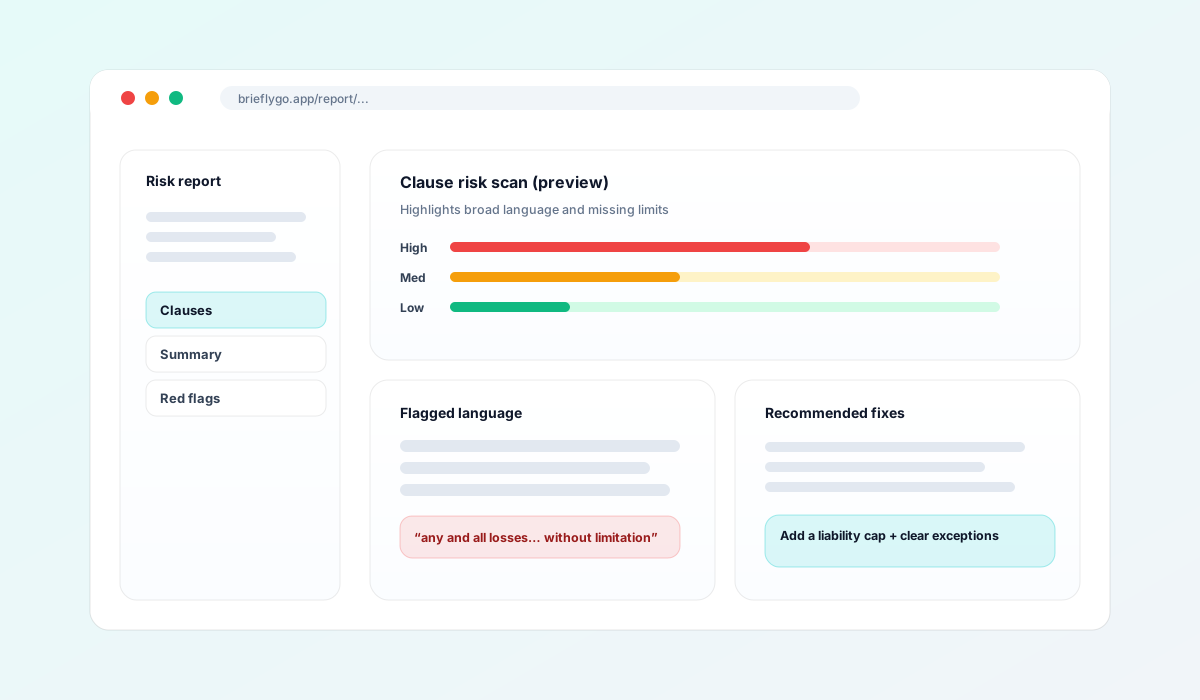
This guide explains force majeure clause in plain English so you can spot red flags fast - even if you're not a lawyer. Use it to scan your contract, find the wording, and know what to negotiate.
Direct answer
The Force Majeure clause defines the specific events under which one party is excused from performing contractual obligations, typically suspending performance during specified natural disasters or unforeseen disruptions. It shifts financial liability when an event occurs, often turning a potential loss into a direct claim against the contract's defined risk matrix. The force majeure provision dictates whether a delay in project execution is excused, thereby changing the cost structure and exit viability of the deal.
Quote
"When you see a good move, look for a better one."
- Emanuel Lasker
Quote
"If you can't explain it simply, you don't understand it well enough."
- Albert Einstein
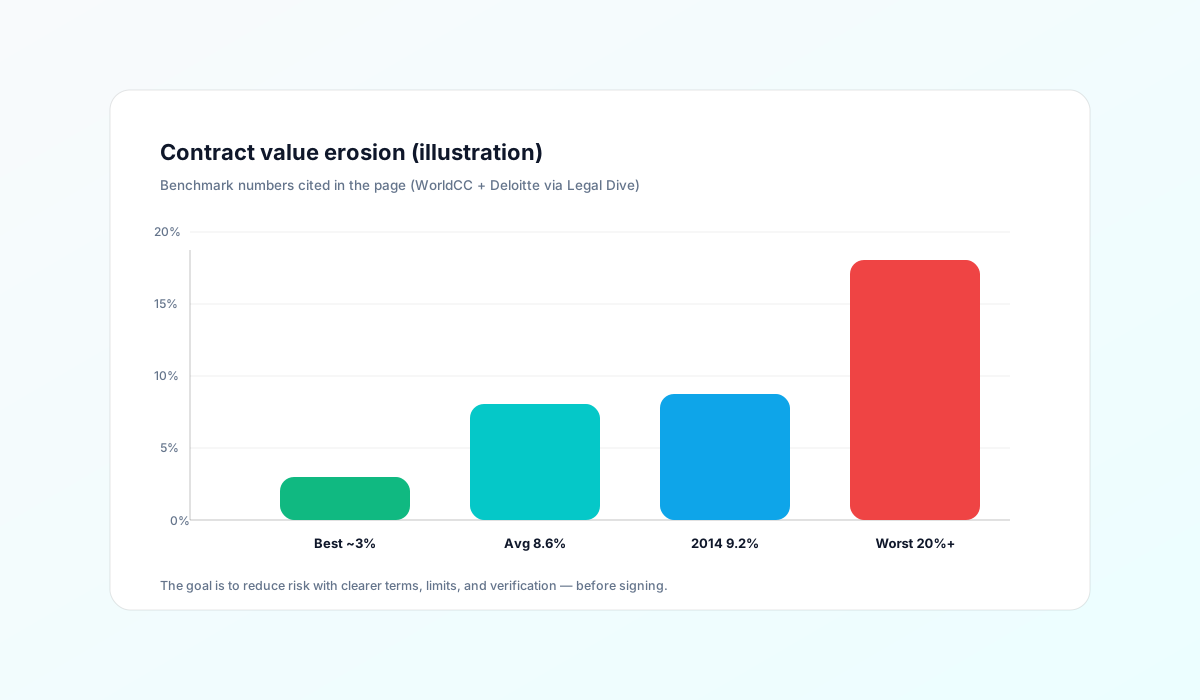
Related stats (business contracts)
Sources: Docusign / Deloitte signals reported by TechRadar and Axios. Treat these as directional business benchmarks, not legal advice.
Why it's risky (specific outcomes)
- A $150,000 project can trigger an $250,000 claim if 'Force Majeure' is defined narrowly.
- The clause shifts liability from 3 years to 6 months for unavoidable delays.
- $50,000 in initial overhead costs shift entirely when the event is a declared force majeure event.
- The clause dictates legal standing regarding performance delays under contract law.
- It sets the threshold for excused non-performance, impacting breach analysis.
- It establishes the scope of excusable delays for the signing party.
- The clause imposes a specific operational constraint on project timelines or delivery dates.
- It mandates an immediate response mechanism for declared events, affecting daily workflow bottlenecks.
- It dictates which external event (e.g., 'Act of God') warrants suspension of required service.
- The clause affects the long-term relationship by dictating how operational failures are officially documented and remedied.
- It determines whether a single event prevents lifetime contract viability or demands a renegotiation.
- It sets precedent for when catastrophic events truly redefine project timelines over several years.
Risk detection board
Red flags to look for
Search for these patterns first. They usually signal hidden cost, one-sided leverage, or a clause that needs a tighter limit before signing.
'Force Majeure' defined exclusively by 'Act of God' or 'perils of nature'.
Ask for a limit, a definition, and a written notice/dispute window.
'Excusable delay' tied to specific enumerated events (e.g., earthquake, flood).
Ask for a limit, a definition, and a written notice/dispute window.
'Mitigation requirement' explicitly stated as mandatory for performance.
Ask for a limit, a definition, and a written notice/dispute window.
'Bailment exception' where the party can still perform despite a force majeure event.
Ask for a limit, a definition, and a written notice/dispute window.
'Contractual obligation' defined by 'Force Majeure clause'.
Ask for a limit, a definition, and a written notice/dispute window.
'Unforeseen circumstances' limited to specific categories.
Ask for a limit, a definition, and a written notice/dispute window.
'Frequency threshold' of declared events specified in the clause.
Ask for a limit, a definition, and a written notice/dispute window.
Scenario replay
Real example: what you can lose
A practical mini-story makes the risk easier to judge than abstract legal wording.
Potential impact
The project lost $100,000 in potential revenue because the force majeure clause allowed the client to terminate without paying the full fee.This is the kind of loss BrieflyGo tries to surface before the document moves to signing.
Who
A small-business operator signing a 2-year service agreement with an established tech company.
Signed
A software vendor agrees to deliver a platform, but the contract specifies that 'Force Majeure' only applies if the event is catastrophic and beyond standard risk assessment.
Trigger
The clause failed because the trigger event was defined as 'severe weather delays', but the actual delay occurred due to minor logistical issues, which were not covered by the specific definition.
Manual scan mode
How to identify it
Use this as a quick search workflow before uploading the contract or asking the other side for changes.
Where to look
Section 3 (Definitions) or Section 8 (Term/Event Definitions) where 'Force Majeure' is defined. Look for clauses defining 'Act of God' or 'Force Majeure events' within the main body.
Phrases to search
'Force Majeure clause''Excusable delay''Acts of God''Mitigation requirement''Unforeseen circumstances''Defined events''Term suspension''Event triggers'Danger pattern
- The clause mandates a specific event type, making it hard to prove the actual delay was excused.
- The risk lies in whether 'Force Majeure' is defined too broadly or too narrowly for the project timeline.
- It creates an operational bottleneck if the required response time for the force majeure declaration is missed.
Redline helper
Risky wording vs safer wording
"Company may change these terms, remedies, fees, or obligations at any time in its sole discretion."
"Any material change must be in writing, signed by both parties, and will not apply retroactively to work already ordered or delivered."
Why this helps: This keeps the contract stable and prevents one-sided changes after signing.
Action board
How to protect yourself
Treat these as practical redline moves: narrow the language, add measurable limits, then re-check the edited document before you sign.
Add: Define a specific 'Force Majeure event' that includes 'unforeseen events occurring within 30 days of contract execution'.
Ask for this change in writing, then verify the final PDF matches the negotiated wording.
Delete: The clause should explicitly state what happens when a force majeure event occurs, especially regarding payment/termination.
Ask for this change in writing, then verify the final PDF matches the negotiated wording.
Modify: Change the definition to include 'forty-eight hour delay' or similar quantifiable metric.
Ask for this change in writing, then verify the final PDF matches the negotiated wording.
Knowledge graph
Legal terms and document paths connected to Force Majeure Clause
This connected layer helps readers and answer engines move from the risky clause itself to nearby glossary explanations and document workflows where the same pressure shows up again.
Upload your contract and detect contract risks instantly using AI.
BrieflyGo scans contracts and highlights risky wording in plain English so you can decide what to accept, what to negotiate, and what to avoid.
No legal jargon overload. Fast scan. Clear red flags.
FAQ
Is this type of clause legal?
Often yes - but legality depends on your location, the exact wording, and the context. Even a legal clause can still be a bad deal for you.
Can it be changed in the draft?
Yes, many clauses can be removed or narrowed. If the other side won't remove it, ask for limits, exceptions, or a trade-off (price, term, scope).
Who benefits from it?
Usually the party with more power in the negotiation. The clause often shifts risk away from them and onto you, especially when it's broad or one-sided.
When does it become dangerous?
When it's broad, has no clear limits, applies after termination, or is tied to large money. It's also risky when the contract has vague definitions or hidden cross-references.