August 14, 2026 · 13 min read
Singapore Tax Deadlines 2026–2027: Every IRAS Date, Who It Applies To, and What It Costs to Miss
A complete guide to Singapore’s 2026–2027 tax year: the 18 April individual deadline, the 30 November corporate return, ECI, GST F5, withholding tax, CPF and AIS — who each one applies to, and the penalties for missing them.
In this article ▾
Quick answer: Singapore's tax year is not one deadline, it is four rhythms running at once. Individuals e-file by 18 April. Companies file an estimate within three months of their financial year end and the actual return by 30 November. GST-registered businesses file one month after each accounting period closes. Employers pay CPF by the 14th of the following month and report every employee's income by 1 March. Miss the fixed ones and you get penalties; miss the rolling ones and you often do not notice until interest has been running for a while.
Last verified: 14 August 2026, against IRAS, the CPF Board, ACRA and the Ministry of Manpower. This article is educational and is not tax advice. A Singapore-registered tax agent, accountant or lawyer should advise on your specific entity, residency and financial year.
Why the Singapore calendar confuses people who arrive from the US or UK
Singapore assesses income on a preceding-year basis. The Year of Assessment 2026 is not about income you are earning now — it is about income you earned during calendar year 2025. That single fact explains most of the confusion. A freelancer who moved from London in early 2026 will look for a deadline in the current tax year and find nothing, because the return sitting in front of them covers the year already closed.
The second surprise is that companies do not share the individual timetable. An individual's basis period is the calendar year. A company's is its own financial year, which is why two companies can both be filing "YA 2026" returns while one closed its books on 31 December 2025 and the other on 30 June 2025. Both file by 30 November 2026; their estimated-income deadlines were eight months apart.
The third is that there is no monthly payroll tax return. Employers in Singapore do not withhold income tax from salary the way a US or UK employer does. The monthly obligation is CPF, a retirement and healthcare contribution, and the annual obligation is telling IRAS what each employee earned. Employees then pay their own tax bill after assessment.
The dates most people are looking for
| Obligation | Deadline | Who it applies to |
|---|---|---|
| Individual income tax, e-filing | 18 April 2026 | Anyone required to file for YA 2026 |
| Individual income tax, paper | 15 April 2026 | The shrinking number still filing on paper |
| Employment income submission (AIS) | 1 March 2026 | Employers, compulsory at 5+ employees |
| Estimated Chargeable Income (ECI) | Within 3 months of financial year end | Companies, unless the waiver applies |
| Corporate income tax return | 30 November 2026 | Every company, including dormant ones |
| GST F5 return and payment | 1 month after each accounting period | GST-registered businesses |
| Withholding tax (Form IR37) | 15th of the 2nd month after payment | Anyone paying a non-resident |
| CPF contributions | 14th of the following month | Employers |
| Property tax | 31 January | Property owners |
| ACRA annual return | Within 7 months of financial year end | Companies (a Companies Act filing) |
Individual income tax: what actually happens between March and September
Filing opens on 1 March on myTax Portal, and the e-filing deadline is 18 April. Paper filers get 15 April — three days earlier, which is a deliberate nudge toward the portal.
Two mechanisms mean many people never touch a form. Under the Auto-Inclusion Scheme, employers send salary data straight to IRAS, so it is already in the return. And for YA 2026 IRAS said around a million taxpayers would receive a Direct Notice of Assessment from mid-March — a finished tax bill with no filing step at all. Others fall under the No-Filing Service, where a pre-filled return is treated as filed unless they change it.
In practice: "I did not have to file" is not the same as "I did not have to check." Auto-inclusion covers employment income. It does not cover freelance work invoiced on the side, rental income from a property, or the reliefs you became eligible for when a child was born or a parent moved in. Those are yours to add, and the deadline for adding them is the same 18 April.
You are generally required to file if your total income for the year exceeded S$22,000, or if you carried on a trade, business, profession or vocation — a sole proprietor or freelancer files even below that threshold. IRAS sets out the tests on its individuals required to file page.
Then comes the part people forget: assessment is not payment. Notices of Assessment go out from around April through September, and tax is due within one month of the date on the notice — even if you have filed an objection. Signing up for GIRO converts the bill into up to twelve interest-free monthly instalments, which is the single most useful cash-flow decision available to a Singapore taxpayer and takes about five minutes.
Companies: file an estimate, then file the truth
A Singapore company files twice for each Year of Assessment.
First, ECI. Estimated Chargeable Income is due within three months of financial year end. A 31 December 2025 year-end files by 31 March 2026; a 30 June year-end by 30 September. The waiver is narrower than people assume: it applies only where annual revenue is S$5 million or below and the ECI is nil. Both tests, not either. See IRAS on ECI filing.
Then the return, by 30 November, e-filed on myTax Portal. Which form depends on size:
- Form C-S (Lite) — annual revenue of S$200,000 or below. The shortest version.
- Form C-S — annual revenue up to S$5 million, plus the other qualifying conditions.
- Form C — everything else. Financial statements and a tax computation must be attached.
Two traps here. The first: dormant and loss-making companies still file. A holding company that did nothing all year has a 30 November deadline like everyone else. The second: ACRA is not IRAS. The annual return filed on BizFile+ within seven months of financial year end is a Companies Act obligation, entirely separate from the tax return, with its own late-filing penalties. ACRA sets out the deadline and requirements; the AGM sits a month earlier still, at six months.
In practice: filing ECI early is not merely tidy. The number of instalments IRAS grants on the resulting tax depends on how promptly the ECI arrives, so a company that files within a month of year end pays the same tax over a longer stretch than one that files on the last permitted day.
GST: 9%, one month after the period closes
GST registration becomes compulsory once taxable turnover for the past twelve months exceeds S$1 million, or once you reasonably expect it to exceed that in the next twelve. Once registered, the GST F5 return and payment are due one month after the end of each accounting period.
Most businesses file quarterly, which puts the four dates at a predictable spacing:
| Accounting period ends | GST F5 due |
|---|---|
| 31 December | 31 January |
| 31 March | 30 April |
| 30 June | 31 July |
| 30 September | 31 October |
Two things catch people out. A nil return is still a return — if you are registered and traded nothing, you file anyway. And GST has been 9% since 1 January 2024, so invoice templates and quoting tools built before then may still be carrying 8% or 7%.
Withholding tax: the deadline nobody diarises
This is the obligation that most often arrives as an unpleasant surprise, because it is triggered by a payment rather than by a date. Pay a non-resident for interest, royalties, management or technical fees, rent on movable property, or as a non-resident director or professional, and you must withhold tax and remit it to IRAS.
The deadline is the 15th of the second month from the date of payment. Pay a consultant in Berlin on 3 January and Form IR37 plus the tax are due by 15 March. Late filing attracts a 5% penalty plus 1% per month. IRAS keeps the forms and guidance under S45 withholding tax.
In practice: the risk here is structural rather than careless. A small company that pays an overseas contractor once creates a withholding obligation the bookkeeper has never seen before, on a clock that started the day the invoice was paid. If you engage non-residents at all, the rule to internalise is not the rate — it is that the clock starts at payment, not at year end.
Employers: CPF monthly, everything else annually
CPF contributions are due at the end of the month the wages relate to, with a grace period to the 14th of the following month. After that, late-payment interest runs at 1.5% per month, subject to a S$5 minimum. The Skills Development Levy is collected through the same submission, so one late submission misses two obligations. The CPF Board's employer pages cover rates and submission.
Annually, by 1 March, employers report each employee's income for the previous year: Form IR8A, plus Appendix 8A for benefits-in-kind, Appendix 8B for share-option gains and Form IR8S for excess CPF contributions. AIS is compulsory for employers with five or more employees; smaller employers outside the scheme must hand each employee a hardcopy IR8A by the same date.
And one obligation has no date on any calendar: Form IR21 tax clearance. File it at least one month before a non-Singapore-Citizen employee ceases employment, goes on an overseas posting, or leaves Singapore for more than three months — and withhold monies due to them until IRAS issues clearance. See tax clearance (IR21). In a city where a notice period is often one month, "one month before departure" means the day the resignation lands.
What the year actually looks like
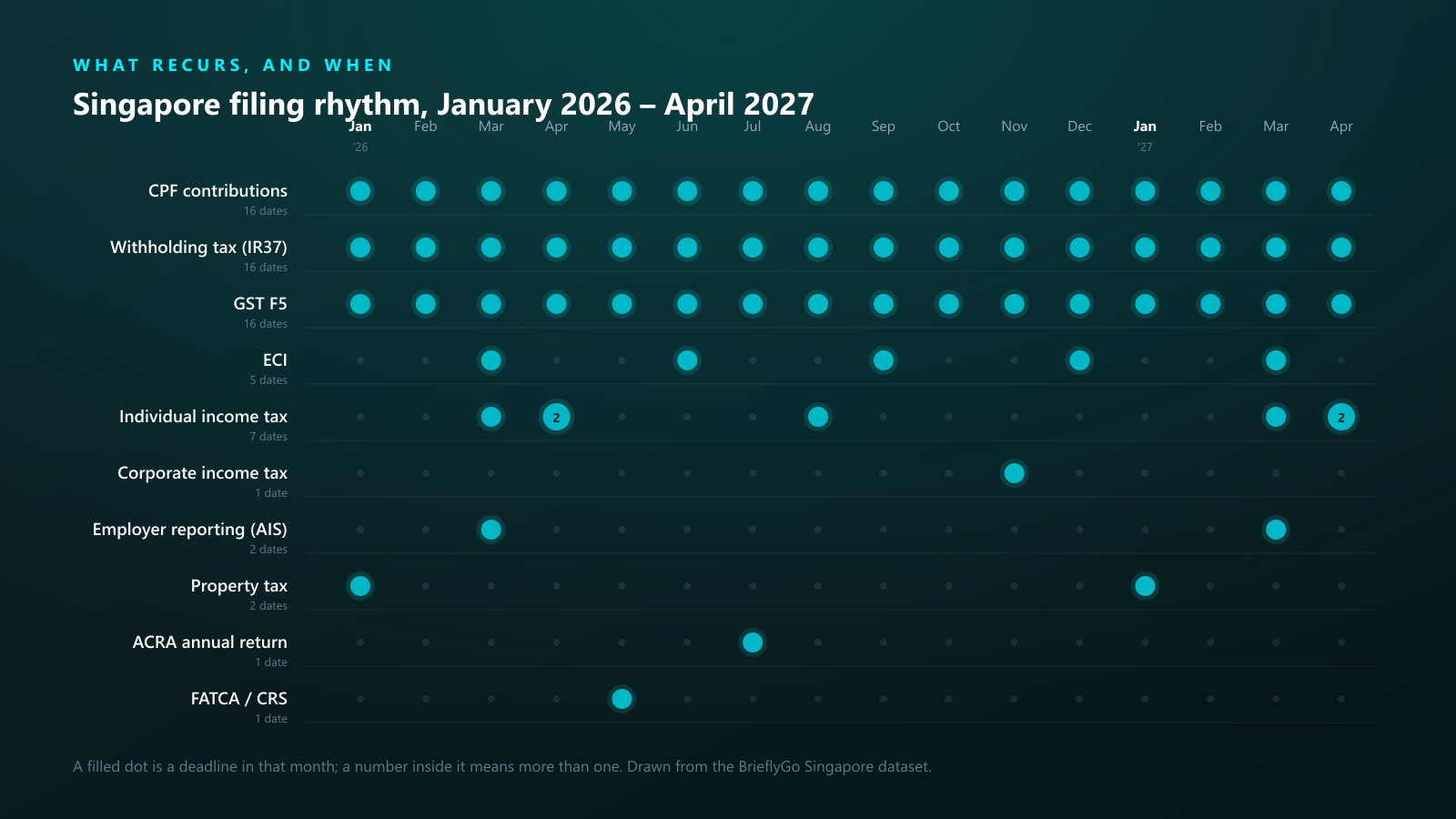
Written out as a list, the Singapore year reads as a jumble. Drawn as a grid, the structure is obvious: three obligations recur every month, one recurs quarterly, and the rest are single annual events clustered in March, April and November.
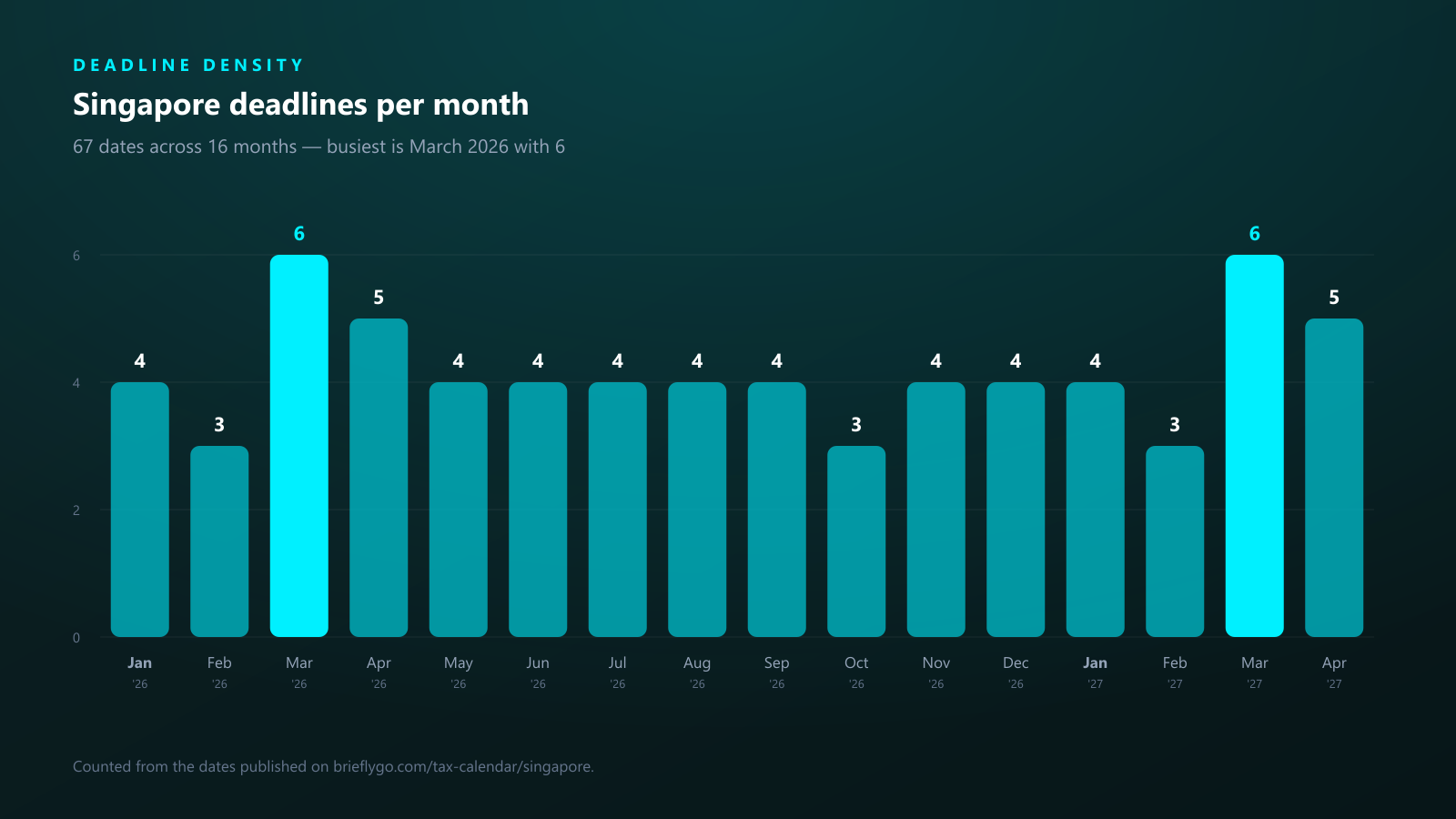
Counting the same data by month shows where the pressure sits. March and April carry the individual filing season, the AIS submission and the most common ECI date all at once — which is precisely when an accountant's capacity is most contested.
The holidays that move, and the next-working-day rule
Where a filing or payment date falls on a Saturday, Sunday or gazetted public holiday, file by the next working day. That matters more in Singapore than in most jurisdictions, because five of the eleven public holidays move each year with the lunar, Islamic and Hindu calendars. In 2026: Chinese New Year on 17–18 February, Hari Raya Puasa on 21 March, Hari Raya Haji on 27 May, Vesak Day on 31 May and Deepavali on 8 November. The Ministry of Manpower publishes the gazetted list of public holidays, and it is worth checking rather than assuming last year's dates.
What it costs to miss a date
- Individual late filing: IRAS may issue an estimated assessment, which must be paid even while you object, plus a composition fee or a court summons for continued non-filing.
- Corporate late filing: composition fees, and prosecution in persistent cases. A notice of assessment based on IRAS's own estimate is the usual first consequence.
- Late payment of tax: generally a 5% penalty, with a further 1% per month while it remains unpaid, up to 12%.
- Late CPF: interest at 1.5% per month, minimum S$5.
- Late withholding tax: 5% penalty plus 1% per month.
- Late ACRA annual return: a late lodgement penalty, rising with how late the filing is.
None of these are ruinous individually. The pattern that hurts is the one where a company misses ECI, then misses the return, then discovers the ACRA annual return was a separate obligation all along — three penalties from one gap in a calendar.
Who these deadlines are for
Different readers need almost disjoint subsets of the same calendar:
- Employees and expats. One date, 18 April, and one habit: check the pre-filled return rather than trusting it. Plus GIRO, so the bill arrives in twelve pieces instead of one.
- Freelancers and sole proprietors. The same April date, but you file regardless of how small the income was, and nothing has been auto-included on your behalf.
- Small companies and startups. Four dates that matter: ECI, 30 November, the ACRA annual return, and — if registered — GST every quarter.
- Employers. A monthly CPF rhythm, one annual reporting date on 1 March, and an IR21 obligation that fires whenever a foreign employee resigns.
- Foreign-owned holding and IP companies. Withholding tax is the live risk, because it is triggered by payments to related parties abroad rather than by a date.
- Property owners. One date, 31 January, against a bill issued the previous December.
What is next, from mid-August 2026
If you are reading this in the second half of August 2026, the dates immediately ahead are:
- 15 August — withholding tax on payments made to non-residents in June.
- 31 August — GST F5 for July, for monthly filers. Notices of Assessment are also landing, each with its own one-month payment clock.
- 14 September — CPF contributions for August.
- 30 September — ECI for companies with a 30 June financial year end.
- 31 October — GST F5 for the quarter ended 30 September.
- 30 November — the YA 2026 corporate income tax return. This is the one to plan backwards from now, because it needs financial statements and a tax computation before it needs a form.
Using the calendar instead of rebuilding it
The BrieflyGo Singapore tax calendar lays all 67 dates out month by month, with a plain-English explanation of each obligation and a link from every form label to the official IRAS, CPF Board or ACRA page that owns it. Three things it does that a static list does not:
- It answers "what is next" above the fold, rather than making you scan a year of dates to find the one that matters today.
- It publishes an iCalendar feed. Subscribe once at /api/tax-calendar/sg and every deadline lands in your own calendar with a reminder a week ahead, instead of being re-read once a quarter.
- It flags the collisions. Deadlines that fall on a gazetted public holiday are marked in place, so the next-working-day rule is visible where you need it.
Singapore sits alongside the calendars for the United States, the United Kingdom, Australia, Ireland and every EU member state — useful if you are running one business across several of them. The tax calendar hub is the way in.
For the paperwork these dates generate rather than the dates themselves, the AI editor opens any PDF for field-by-field guidance, and the invoice generator will produce a GST-ready invoice without a spreadsheet.
Official sources
- IRAS — the Inland Revenue Authority of Singapore, and myTax Portal for filing.
- Tax Season 2026 — the individual filing season in IRAS's own words.
- Corporate Income Tax Filing Season 2026 and Form C-S / C-S (Lite) / C filing.
- Estimated Chargeable Income (ECI) filing.
- Filing GST and GST registration.
- S45 withholding tax forms.
- Auto-Inclusion Scheme and tax clearance (IR21).
- Property tax and stamp duty.
- CPF Board, for employers.
- ACRA, annual return deadlines.
- Ministry of Manpower, public holidays.
Deadlines change, and your own obligations depend on your residency, entity type and financial year. Verify any date you are planning against the authority that owns it, and speak to a qualified Singapore tax professional before relying on anything here.
Share this article
Summarize with AI(opens AI chat with article URL · Gemini: prompt copied to clipboard)
BrieflyGo AI
Don't sign before you know what you're signing.
Upload any contract — NDA, SOW, lease, or employment agreement — and get an instant AI risk report with clause-by-clause explanations.
Explore FormGuardian
Contract Types to Review
Check Commercial Lease Terms for Hidden Costs
Upload a Commercial Lease Terms to spot risky clauses, payment traps, ownership issues, and negotiation pressure points before you sign.
Learn more →
Check a Commission Plan for Payment and Quota Risks
Upload a Commission Plan to spot risky clauses, payment traps, ownership issues, and negotiation pressure points before you sign.
Learn more →
Analyze a Promissory Note Before Lending or Borrowing
Upload a Promissory Note to spot risky clauses, payment traps, ownership issues, and negotiation pressure points before you sign.
Learn more →
Contract Risk Library
Common Clause Risks
Free for your first contract
Spot the risk before you sign.
BrieflyGo flags hidden liabilities, unfair clauses, and missing protections in seconds.